Bedford-Stuyvesant holds one of the deepest reserves of Victorian rowhouse architecture in the United States, and the interiors are the reason designers keep coming back. The neighborhood contains roughly 8,800 buildings constructed before 1900, a stock frequently cited as the largest intact collection of Victorian architecture in the country, and the prevailing interior approach is preservation first: keep the parlor floor’s woodwork, plaster, and pier mirrors, then push the modern work down to the garden level.
That formula was not invented by a design firm. The houses came through the disinvestment of the mid twentieth century with their pocket doors and carved mantels largely intact, in great part because the Black families who bought here from the 1930s onward maintained them through decades when banks redlined the neighborhood and the city looked away. The detail that sells a Bed-Stuy brownstone today survived because people kept it alive. Any honest account of the neighborhood’s interiors starts there.
Key takeaways
- Bed-Stuy contains roughly 8,800 pre-1900 buildings, frequently cited as the largest intact collection of Victorian architecture in the United States.
- Four historic districts protect the core: Stuyvesant Heights (1971), the expanded district (2013), Bedford (2015), and Willoughby-Hart (2024).
- The dominant interior style keeps original parlor-floor detail and concentrates kitchens and modern systems on the garden level.
- The Landmarks Preservation Commission regulates facades and stoops, not most private interiors. Ordinary repairs need no landmarks permit at all.
- Tompkins Avenue is the design retail spine, anchored by Peace & Riot and Sincerely, Tommy.
Four historic districts, one building boom
The architecture arrived fast. Stuyvesant Heights filled in between the 1870s and the early 1900s, when developers built speculative rowhouses for Brooklyn’s expanding middle class. In the Bedford section, nearly 90 percent of the houses went up in a single stretch from the late 1870s to the early 1890s. The styles run from Italianate and Neo-Grec through Queen Anne, Romanesque Revival, and Renaissance Revival, often several on a single blockfront. Architects like Magnus Dahlander, Axel Hedman, and Montrose Morris worked here at volume. Morris’s Alhambra Apartments on Nostrand Avenue, built 1889 to 1890, remain the grandest statement of the period’s ambition.
The city’s Landmarks Preservation Commission designated the Stuyvesant Heights Historic District in 1971, covering more than 400 buildings around MacDonough, Decatur, and Macon Streets. The Bedford-Stuyvesant/Expanded Stuyvesant Heights district followed in 2013 with roughly 825 more. The Bedford Historic District, 824 buildings, was designated on December 8, 2015. The newest addition came in 2024, when the commission voted on June 25 to protect Willoughby Avenue and Hart Street between Nostrand and Marcy Avenues, with City Council approval following that September.
| Historic district | Designated | Scale |
|---|---|---|
| Stuyvesant Heights | 1971 | More than 400 buildings |
| Bedford-Stuyvesant/Expanded Stuyvesant Heights | 2013 | Roughly 825 buildings |
| Bedford | 2015 | 824 buildings |
| Willoughby-Hart | 2024 | Willoughby Avenue and Hart Street, Nostrand to Marcy |
If the typology itself is new to you, start with our primer on what a brownstone actually is, then browse the rest of our neighborhood guides.
What a Bed-Stuy parlor floor looks like
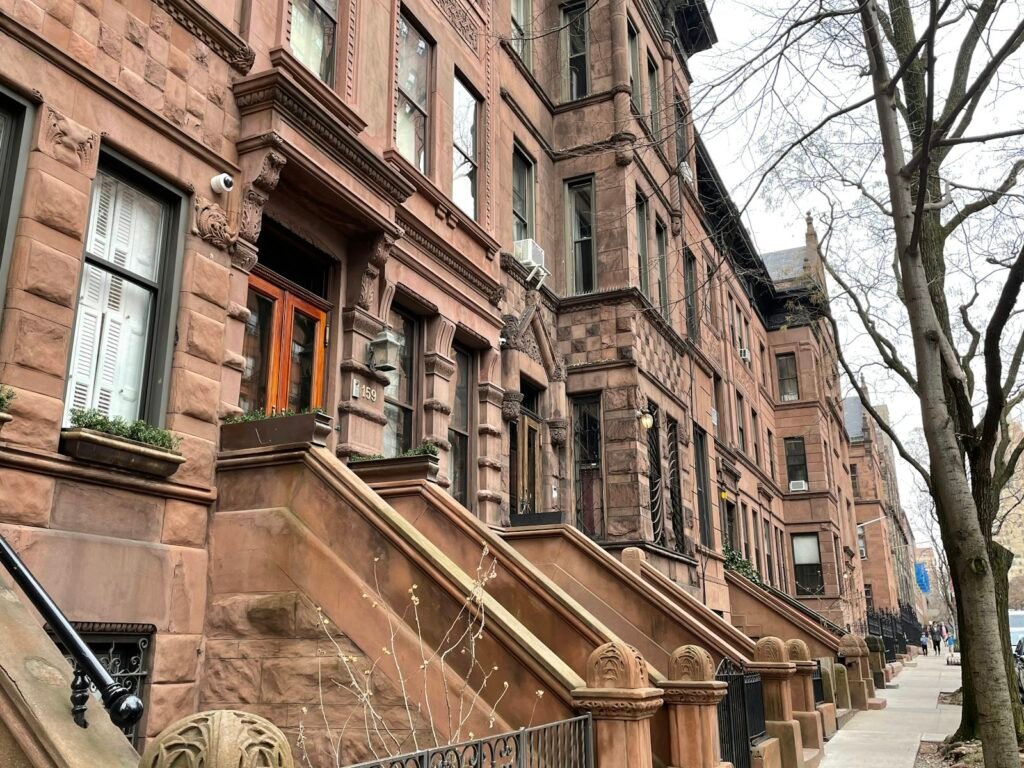
The standard house rises three or four stories, with a raised parlor floor reached by a stoop of eight to twelve steps. Inside, the parlor level carries the weight: paired parlors divided by pocket doors, plaster cornices, carved wood mantels, stained glass, and pier mirrors set between the front windows. Outside, the cast-iron newel posts, railings, and areaway gates form a catalog of the Victorian decorative arts trade. The blocks of MacDonough, Decatur, and Bainbridge Streets between Stuyvesant Avenue and Malcolm X Boulevard hold some of the most complete examples in New York.
The renovation pattern documented across the neighborhood is consistent. Owners restore rather than replace on the parlor floor: missing runs of plaster get recast from intact sections, shutters come out of their pockets, and hardware is cleaned and rehung. In one project featured by Brownstoner, about three quarters of the original hardware went back on the doors, with salvage sourced to match the rest. Kitchens move to the garden level, where ceilings are lower and the original detail was always plainer, and bathrooms absorb most of the modern budget.
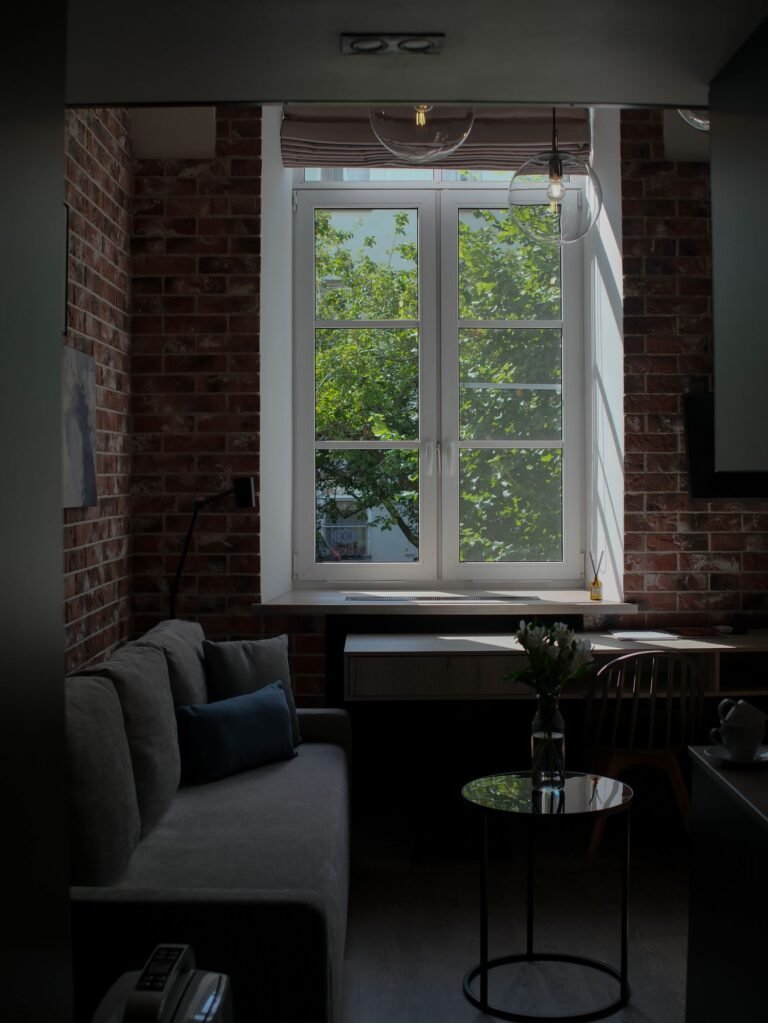
The styling sits apart from the gray-and-white minimalism that defined Brooklyn renovations a decade ago. Bed-Stuy interiors tend toward saturated paint colors, pattern, and objects sourced from across the African diaspora alongside midcentury and contemporary pieces. The effect is closer to a collected family house than a staged one. For contrast, see how the same bones get handled elsewhere in our guides to Park Slope brownstone interiors and Harlem brownstone interiors.

Where locals shop for the look
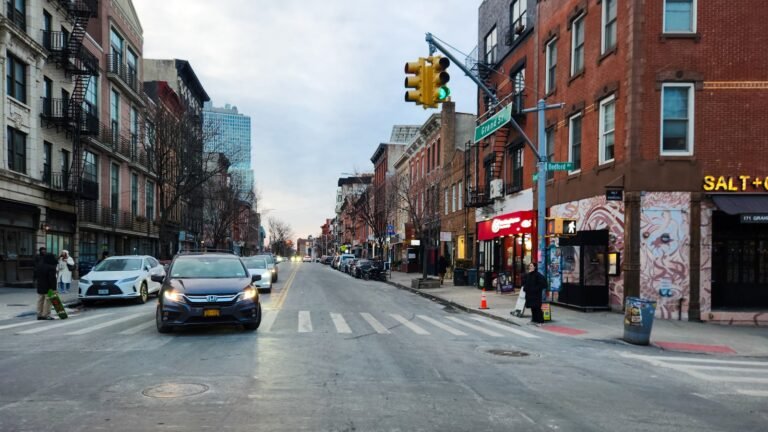
Tompkins Avenue is the retail spine. Peace & Riot stocks home goods grounded in Black culture across the diaspora: Moroccan poufs, candles, ceramics, and Brooklyn art. A few blocks away at 343 Tompkins Avenue, Sincerely, Tommy has run since 2014 under founder Kai Avent-deLeon, mixing emerging womenswear with lifestyle objects and an in-store coffee counter. Both were operating as of mid 2026, and both double as a reliable read on the neighborhood’s visual taste.
For research rather than shopping, two resources do the heavy lifting. Brownstoner’s Insider column has documented dozens of Bed-Stuy renovations in detail, down to hardware counts and plaster repairs. The Bedford Stuyvesant Preservation Coalition maintains current district maps and tracks proposed designations, which is worth checking before you buy or plan exterior work.
Renovation notes: what landmark status actually regulates
Landmark designation worries buyers more than it should. The Landmarks Preservation Commission regulates the exterior: facades, stoops, cornices, windows, and anything that changes the building’s protected features. Most interior work in a private house needs no LPC review at all, unless the job requires a Department of Buildings permit that affects the exterior, like moving a window or venting a range hood through the front facade.
Ordinary repairs are exempt. Replacing broken glass or repainting in the existing color requires no landmarks permit. For interior renovations that do need DOB permits, the commission issues staff-level approvals, called a Certificate of No Effect, without a public hearing. The real landmark costs show up outside. Brownstone is a soft sandstone veneer, and resurfacing a failing facade or rebuilding a stoop to LPC standards is skilled, regulated work. Budget for it the way you would budget for a roof.
Planning a gut job rather than a restoration? Our NYC renovation guide covers permits, timelines, and costs in more depth.

Frequently asked questions
Is Bed-Stuy really the largest collection of Victorian brownstones in the country?
The careful version of the claim: Bedford-Stuyvesant contains roughly 8,800 buildings built before 1900, frequently cited as the largest intact collection of Victorian architecture in the United States. Not all of them are brownstones. The stock includes brick rowhouses, wood-frame houses, and apartment buildings like the Alhambra. The brownstone share is still enormous, and the four historic districts protect well over 2,000 buildings between them.
Do landmark rules limit what I can do inside?
Mostly no. The LPC does not regulate the interiors of private homes unless an interior is separately landmarked, which is rare for rowhouses. Interior work triggers landmarks review only when it changes the exterior. Standard Department of Buildings permit rules still apply everywhere, in and out of historic districts.
How do Bed-Stuy interiors differ from Park Slope or Harlem?
The bones are similar. The survival rate and the styling are not. Bed-Stuy’s stock came through the twentieth century with an unusual amount of original interior detail intact, so restoration plays a bigger role here than reinvention. The current look also leans harder on color and diaspora sourcing than Park Slope’s quieter palettes. Harlem’s rowhouses are the closest cousins in both history and spirit.
Which historic districts protect Bed-Stuy?
Four: Stuyvesant Heights (1971), the expanded district (2013), Bedford (2015), and Willoughby-Hart (2024). The Landmarks Preservation Commission regulates facades and stoops, not most private interiors.
Sources
- Historic Districts Council: Stuyvesant Heights Historic District
- Wikipedia: Bedford-Stuyvesant, Brooklyn
- CityLand: Bed-Stuy/Expanded Stuyvesant Heights Historic District Designated
- New York YIMBY: Bedford Historic District Designated
- NYC Landmarks Preservation Commission: Permits and Making Alterations
- Brownstoner: Bed Stuy Brownstone Reno Blends Original Detail with Modern Elements