A brownstone is a city rowhouse with a front facade of brown sandstone, a soft sedimentary stone quarried mainly in Connecticut and New Jersey during the 1800s. The word describes the cladding, not the building: behind the stone face, nearly every brownstone is a brick structure.
New York uses the word loosely. Listings will call almost any 19th-century rowhouse a brownstone, including houses fronted in brick or limestone. Purists hold the line: no brown sandstone, no brownstone. This guide covers the strict definition, where the stone came from, why builders loved it and later cursed it, what the houses look like inside, and where the great brownstone blocks still stand.
Key takeaways
- The name refers to a material, not a style: a brown, iron-rich sandstone quarried at Portland, Connecticut and in northern New Jersey.
- Most brownstones are brick rowhouses wearing a sandstone veneer just a few inches thick.
- The boom ran from roughly the 1840s to the 1890s. Italianate and Neo-Grec are the two dominant facade styles.
- The classic layout runs vertically: stoop up to the parlor floor, kitchen at the garden level, bedrooms above.
- Bedford-Stuyvesant holds the city’s largest stock. Park Slope, Harlem, Brooklyn Heights, Cobble Hill and Fort Greene have the most celebrated blocks.
- The stone is porous and flakes over time. Full facade restoration commonly runs $20,000 to $100,000 or more.
What makes a brownstone a brownstone
Start with the stone. Brownstone is a feldspathic sandstone laid down in the Triassic and Jurassic periods, roughly 200 million years ago. Freshly cut, it reads pinkish. Exposed to air, the iron in the stone oxidizes and the surface deepens to the chocolate brown that named both the material and the houses. The two great sources were the quarries at Portland, Connecticut, on the east bank of the Connecticut River, where commercial quarrying began in 1783, and the Passaic Formation quarries of northern New Jersey. Barges carried the blocks down the river and across to Manhattan and Brooklyn.
Builders liked brownstone for two plain reasons. It cost less than marble, limestone or granite, and it was soft enough to carve quickly, which made the era’s heavy ornament affordable. The same softness is why facades flake today.
Now the building type. A brownstone is a subset of the rowhouse. Every brownstone is a rowhouse or townhouse, but the reverse does not hold. A red-brick Federal house in Brooklyn Heights is a townhouse. A limestone row in Crown Heights is a limestone, and brokers will correct you. The distinctions:
| Term | What it describes | Facade material |
|---|---|---|
| Rowhouse | One house in a continuous line of attached houses sharing side walls | Anything: brick, brownstone, limestone, wood, vinyl |
| Townhouse | Any multi-story, single-family city house, attached or freestanding | Anything |
| Brownstone | A rowhouse or townhouse faced specifically in brown sandstone | Brown sandstone veneer, almost always over a brick structure |
One more wrinkle: the brownstone front is a veneer. The stone was cut into slabs a few inches thick and applied over a brick shell, the 19th-century version of cladding. The houses are brick buildings in stone coats.
Is a brownstone a house?
Yes. A brownstone is a house, specifically a rowhouse or townhouse with a brown sandstone front. The word names the facade material, not the number of units inside, so a brownstone house can be lived in many ways. When these blocks went up between the 1840s and the 1890s, almost every brownstone house was built as a single-family home, with one family spread across the parlor, garden and bedroom floors.
That changed in the 20th century. As demand for rentals rose, owners carved many single-family houses into two, three or four apartments, keeping the stone face intact while reworking the floors behind it. A converted brownstone is still a brownstone house; it just holds several units now instead of one. In recent years the trend has partly reversed, with buyers reuniting multi-unit houses back into single-family homes.
This is why “owning a brownstone” can mean two different things. It can mean owning the entire building, the way you own a detached house, with full control and full responsibility for the roof, facade and systems. Or it can mean owning one apartment inside a brownstone that was converted to condos or co-op shares. When someone calls their home a brownstone house, ask whether they mean the whole building or a unit within it. The answer changes the price, the upkeep and the rules.
A short history
Brownstone rows appeared in the 1840s as New York’s population surged, first in Manhattan neighborhoods like Greenwich Village, Madison Square and Murray Hill. Taste played a part. The Romantic decades preferred somber, natural-looking stone to the cheerful red brick of the Federal city. Economics played a bigger one. The quarries were close, the stone was cheap, and speculative builders could run up a uniform row and carve it ornately without marble budgets. From about 1850 to 1890, production was so relentless that historians call the period the Brownstone Era. At its peak, the Portland quarries alone employed more than 1,500 workers.
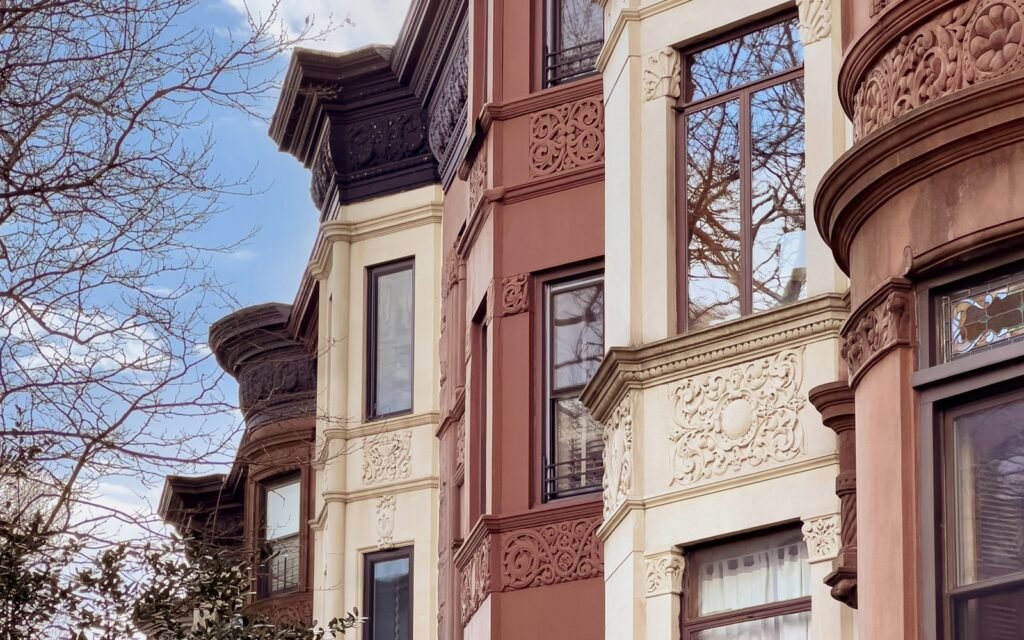
Two styles dominate. Italianate, the signature of the 1850s through the 1870s, gave the city its tall stoops, arched double doors, heavily bracketed cornices and curving, foliate ornament modeled loosely on Italian palazzi. Neo-Grec took over after about 1865: angular, incised, geometric detail cut by machine rather than carved by hand, a sharper and more severe face for the same brick box. Later decades drifted to Romanesque Revival and Renaissance Revival fronts, often in brick and limestone, and by the 1890s brown sandstone had fallen from fashion.
Not everyone mourned. Edith Wharton dismissed the brownstone city of her childhood as cursed with “its universal chocolate-coloured coating of the most hideous stone ever quarried.” The quarries themselves died by water: a 1936 flood and the 1938 hurricane drowned the Portland pits, and commercial extraction never recovered.

The classic layout inside
A typical brownstone is 16 to 20 feet wide, sometimes 25, and three to five stories tall over a cellar. The plan is vertical, organized by the stoop, a word New York kept from the Dutch stoep. The stoop carried the owners and their guests up half a flight to the formal entrance, while a service door tucked beneath it served the household’s working floor.
The garden level sits a few steps below the street. Historically it held the kitchen, the family dining room and service space, with ceilings around 7.5 to 8 feet and a door to the rear yard. The parlor floor above is the showpiece: ceilings of 11 to 12 feet, oversized windows, and the classic double parlor, two formal rooms divided by pocket doors that slide open for entertaining. The floors above held bedrooms, with ceiling heights stepping down as you climb, since the top floors originally housed children and servants.
Original detail is the currency of these houses. Look for pocket doors, marble mantels, plaster crown moldings and ceiling medallions, carved newel posts and banisters, parquet floors, pier mirrors between parlor windows, and interior shutters that fold away into the window jambs. Surviving woodwork in untouched houses, especially in Bedford-Stuyvesant, can be remarkable.
Where to find brownstones in New York
Brownstone blocks survive across Brooklyn and Manhattan, much of the best protected by historic district designation. Explore the rest of our neighborhood guides for deeper dives. The shortlist:
- Park Slope: the textbook brownstone neighborhood, with long Italianate and Neo-Grec rows sloping toward Prospect Park. See our guide to Park Slope brownstone interiors.
- Bedford-Stuyvesant: more brownstones than any other neighborhood in New York, with Stuyvesant Heights holding some of the most intact Victorian streetscapes in the country.
- Harlem: grand late-1800s rows around Mount Morris Park and Hamilton Heights. See our guide to Harlem brownstone interiors.
- Brooklyn Heights: the city’s first designated historic district, protected since 1965, mixing brownstones with earlier brick Federal and Greek Revival houses.
- Cobble Hill and Carroll Gardens: quieter rows south of Atlantic Avenue, including Carroll Gardens blocks with unusually deep front gardens. See our guide to Cobble Hill and Carroll Gardens interiors.
- Fort Greene and Clinton Hill: Italianate and Neo-Grec rows ringing Fort Greene Park, alongside freestanding mansions on Clinton Avenue.
- Upper West Side: brownstone side streets in the 70s and 80s between the avenues’ apartment houses.
Owning a brownstone today
The romance comes with a maintenance bill, and the bill is mostly about water. Brownstone is porous. It absorbs rain, and freeze-thaw cycles pry the surface apart. Worse, 19th-century masons often set the slabs face-bedded, with the stone’s natural layers standing vertical and parallel to the street, so the facade peels in sheets, a failure called delamination. Decades of bad cement patches accelerated the damage on many houses.
Proper repair means composite patching: a tinted, lime-based restoration mortar built up in layers and tooled to match the original surface, not hardware-store cement and never waterproof sealers, which trap moisture and make spalling worse. A full facade restoration commonly runs $20,000 to $100,000 and beyond, depending on the amount of carved detail. Stoops, cornices, lintels and repointing carry their own line items.
If the house sits in a historic district, facade work needs a Landmarks Preservation Commission permit. Routine brownstone repair usually qualifies as minor work approved at staff level, and filing fees are small next to construction costs, starting at $95 for the first $25,000 of work. Interior renovation has its own math: see our guide to bathroom renovation costs in NYC and the rest of our renovation guides.

Frequently asked questions
Why is it called a brownstone?
The name comes from the stone itself. The sandstone is pinkish when first quarried and darkens to deep brown as its iron content oxidizes in the air. The material was simply called brownstone, and by the mid-1800s the name had transferred to the houses faced with it.
Are brownstones only in Brooklyn?
No. Brooklyn has the deepest stock, led by Bedford-Stuyvesant and Park Slope, but Manhattan has major concentrations in Harlem and on the Upper West Side, and the same stone fronts rowhouses in Hoboken, Jersey City, Boston’s South End and parts of Philadelphia, Baltimore and Chicago. Brooklyn made the brownstone famous; it never had a monopoly.
How much does a brownstone cost to maintain?
The big-ticket item is the facade: full restoration typically lands between $20,000 and $100,000, with heavily carved fronts costing more. Beyond the stone, owners budget for roof and cornice work, repointing, stoop repair and drainage, because nearly every brownstone problem starts with water. In historic districts, add Landmarks Preservation Commission approvals to the timeline, though fees themselves are modest.
Is a brownstone a house or an apartment building?
It can be either. A brownstone is a house by type, a rowhouse faced in brown sandstone, and most were built as single-family homes. Many were later split into apartments, so a brownstone house today might hold one family or several. The sandstone facade is what makes it a brownstone, not whether it is a single home or a multi-unit building.
What is the typical layout of a brownstone?
The classic layout runs vertically: stoop up to the parlor floor, kitchen at the garden level, bedrooms above.
Sources
- Wikipedia: Brownstone
- Connecticut History: Portland Puts Its Stamp on an Architectural Era
- StreetEasy: How the Brownstone Became a City Classic
- Brick Underground: Brownstones, Townhouses, and Rowhouses
- Brownstoner: Everything You Need to Know About Neo-Grec
- NYC Landmarks Preservation Commission: Permit Fees
- Apartment List: What Is a Brownstone?
- Historical Windows NY: Is It a Brownstone or a Townhouse?