Fort Greene and Clinton Hill hold the most architecturally complete 19th-century housing stock in Brooklyn, and the interiors follow the architecture: tall parlor floors furnished with collected, design-literate restraint instead of showroom polish. The two neighborhoods sit side by side east of Flatbush Avenue, and together they cover nearly every American residential style built between 1840 and 1890. Greek Revival clapboard houses. Italianate brownstone rows. Freestanding mansions on Clinton Avenue paid for with Standard Oil money. Decorating here means responding to rooms that already have strong opinions.
This guide covers the three building types, the prevailing interior style, the local sources worth knowing in 2026, and the landmark rules that govern renovation in both historic districts. For the rest of our borough-by-borough coverage, browse the neighborhoods archive.
Key takeaways
- The Fort Greene Historic District was designated on September 26, 1978 and protects more than 700 buildings, most of them three- and four-story row houses built between 1840 and 1890.
- Clinton Avenue was once called the Gold Coast of Brooklyn. Oil refiner Charles Pratt built his own mansion at 232 Clinton Avenue in 1874, then gave houses to three of his sons. Four Pratt mansions survive at 229, 232, 241, and 245 Clinton Avenue.
- The area holds the largest concentration of pre-Civil War wood-frame houses in New York City, originally built for Brooklyn Navy Yard workers.
- The local interior style is collected and creative: original plaster, mantels, and shutters kept intact, then furnished with vintage pieces, art, and books rather than matched sets.
- Both neighborhoods carry landmark protections, so street-facing exterior work needs a Landmarks Preservation Commission permit. Most interior work does not.
The architecture: three building types in twenty blocks
Italianate brownstone rows
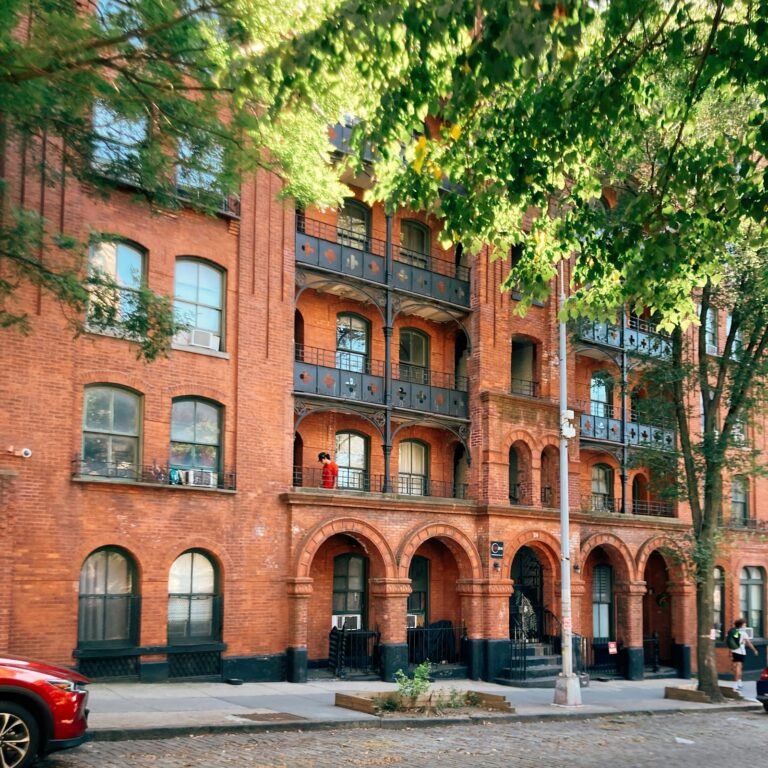
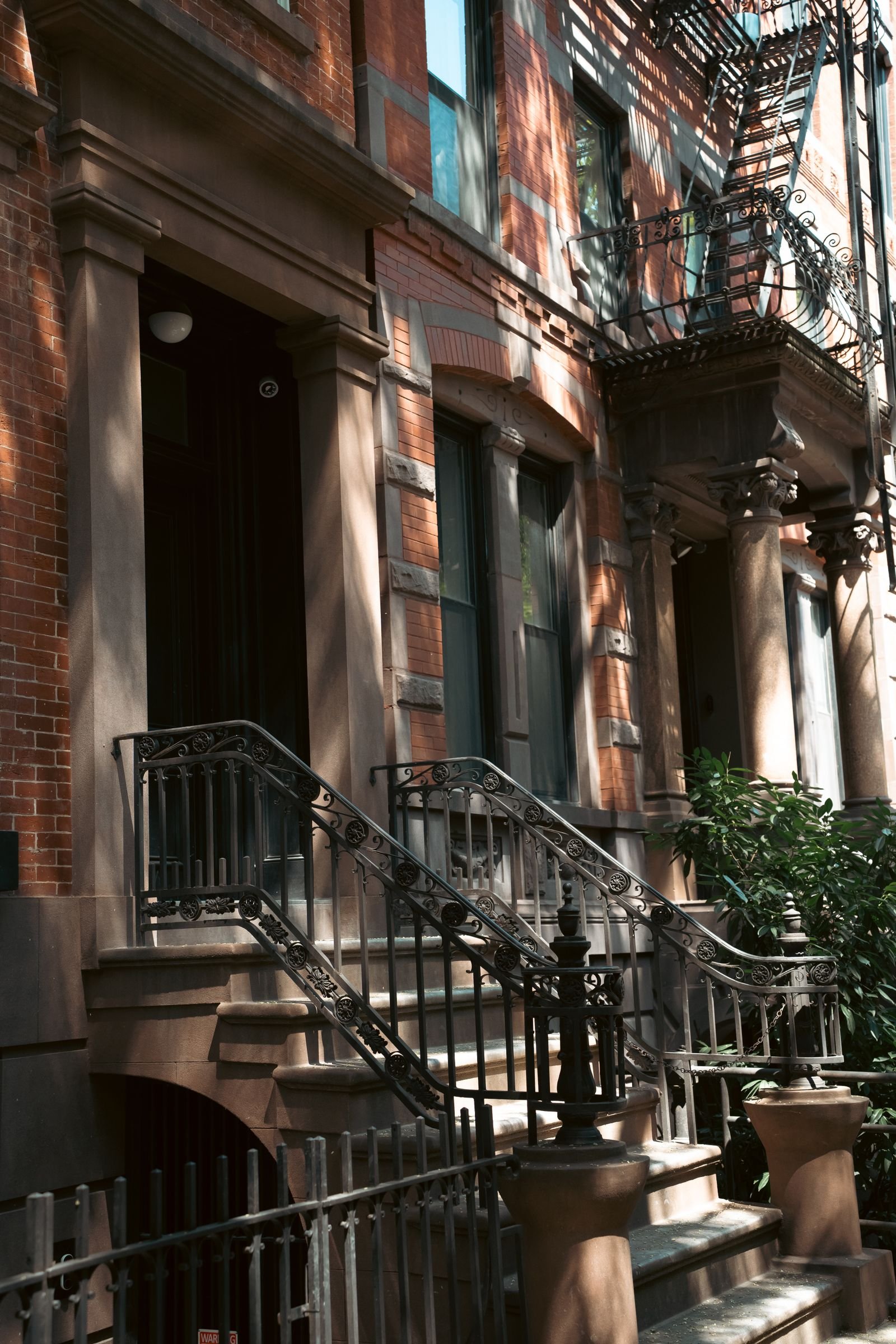
Fort Greene built fast and built well. The historic district, designated by the Landmarks Preservation Commission in 1978, covers one of the most intact 19th-century streetscapes in the country: speculative row houses in Greek Revival, Italianate, Second Empire, and Neo-Grec styles, most faced in soft sandstone quarried in New Jersey, Connecticut, and Ohio. Italianate dominates. Heavy bracketed cornices, arched double doors, high stoops rising past rusticated basements to raised parlor floors. If the material itself is new to you, start with our primer on what a brownstone actually is.
Inside, the Italianate plan is the classic Brooklyn template: double parlors divided by pocket doors, marble mantels, plaster crown and ceiling medallions, and a long run of windows at the parlor front. The rooms are vertical. Furniture that sits low and long, a habit borrowed from mid-century pieces, balances the height instead of fighting it.
The wood-frame survivors
Fort Greene and Clinton Hill hold the city’s largest concentration of pre-Civil War wood-frame houses, most built as housing for workers at the nearby Brooklyn Navy Yard. New wood construction was banned in the city in the 1830s over fire risk, which makes the survivors genuine rarities. The clapboard pair at 448 and 450 Waverly Avenue, dated to the 1840s or earlier, are considered the purest Greek Revival examples in the Clinton Hill district.
Wood frames give a different interior brief than brownstones: lower ceilings, lighter proportions, simpler trim. Owners who do them well lean into the farmhouse bones with painted floors, flat-panel millwork, and plain linen at the windows, and skip the formal Victorian vocabulary entirely.
The Clinton Avenue mansions
Charles Pratt made his fortune refining kerosene, sold his company into Standard Oil in 1874, and built his own brick mansion at 232 Clinton Avenue that same year. He then gave each of three sons a house on the avenue as a wedding present and encouraged his colleagues to build nearby. Other millionaires followed, and Clinton Avenue earned its Gold Coast nickname. Four Pratt mansions still stand at 229, 232, 241, and 245 Clinton Avenue; the house at 229, built for Frederic Pratt by Babb, Cook and Willard, faces the street with a full Roman colonnade. Pratt also founded Pratt Institute in 1887, three blocks away, and the school still anchors the neighborhood’s design culture. The Clinton Hill Historic District was listed on the New York and National Registers of Historic Places in 1985.
| Building type | Typical dates | What it means inside |
|---|---|---|
| Italianate brownstone row house | 1850s to 1870s | Double parlors, pocket doors, marble mantels, tall windows |
| Wood-frame clapboard house | 1840s and earlier | Lower ceilings, simpler trim, farmhouse proportions |
| Freestanding Clinton Avenue mansion | 1874 to 1890s | Grand stair halls, carved paneling, institutional-scale rooms |
The interior style: collected, creative, design-literate
The design culture here is old and earned. Walt Whitman, editing the Brooklyn Daily Eagle, campaigned in print in 1847 for the public park that became Washington Park that year, renamed Fort Greene Park in 1897. Frederick Law Olmsted and Calvert Vaux redesigned it in 1867. Stanford White of McKim, Mead and White gave it the 149-foot Doric column of the Prison Ship Martyrs’ Monument, dedicated in 1908. That same year the Brooklyn Academy of Music, chartered back in 1859, opened its Renaissance Revival home by Herts and Tallant on Lafayette Avenue, now the Peter Jay Sharp Building. Add Pratt Institute’s steady output of designers, and you get a neighborhood where an unusual chair gets recognized on sight.
The rooms reflect that literacy. The prevailing approach keeps original fabric intact, then furnishes against it with things that have biographies: a flea-market credenza, studio pottery, framed works on paper hung to the ceiling line, open shelves of actual read books. Color gets used with more nerve than in comparable brownstone neighborhoods. Deep greens and oxblood reds on parlor walls, painted ceilings, kitchens in unfitted, furniture-like configurations. Where Park Slope brownstone interiors tend toward polished, family-proofed calm, Fort Greene and Clinton Hill rooms take more visible risks.
Where locals actually shop
Retail in these neighborhoods turns over quickly, so we list only sources confirmed operating in 2026. Clic, the decor and book shop that occupied the former Bird space at 85 Lafayette Avenue, closed earlier this year.
- YU Interiors, 15 Greene Avenue at Fulton Street. A Fort Greene fixture since 1999. Vintage furniture, classic mid-century chairs, porcelain vases, and hand-poured candles.
- Brooklyn Flea, Fort Greene. The market’s flagship runs Saturdays from April through November in the 40,000-square-foot schoolyard at Bishop Loughlin Memorial High School, with roughly 150 vendors. The 2026 season opened April 5. It is the best local hunting ground for case goods, lighting, and prints.
- Pratt Institute campus. Not a store, but the campus sculpture collection and the school’s public programming function as a free design education three blocks off Clinton Avenue.
Renovation notes for the historic districts
Both neighborhoods sit substantially within designated districts, and the Landmarks Preservation Commission reviews most changes visible from the street. The practical rules, per the LPC’s published guidance:
- Ordinary repairs and maintenance, like replacing broken window glass or caulking, need no LPC permit.
- Street-facing replacement windows must match the historic profiles, which rules out most off-the-shelf vinyl and aluminum units. Many owners restore original wood sashes and add interior storms instead.
- Work that conforms to LPC rules is approved at staff level, which covers roughly 90 percent of applications. Facade alterations and additions outside the rules require a Certificate of Appropriateness, a public hearing, and a community board presentation.
- Interior renovations generally need Department of Buildings permits but not LPC review, unless the work affects the protected exterior.
Budget accordingly. Landmark-grade exterior work carries real costs, and the sequencing questions are the same ones we cover in our guide to apartment renovation in NYC: scope first, approvals second, demolition last.
Frequently asked questions
Is Fort Greene a historic district?
Yes. The Landmarks Preservation Commission designated the Fort Greene Historic District on September 26, 1978, protecting more than 700 buildings. Neighboring Clinton Hill carries its own protections, and its district was listed on the New York and National Registers of Historic Places in 1985.
What is the difference between Fort Greene and Clinton Hill houses?
Fort Greene is denser and more uniform: block after block of brownstone rows from the 1850s through the 1870s. Clinton Hill has rows too, but adds freestanding mansions and villas along Clinton and Washington Avenues, plus the wood-frame workers’ houses built near the Brooklyn Navy Yard. Clinton Hill offers more variety per block; Fort Greene offers the more complete streetscape.
Do I need a permit to renovate inside a Fort Greene brownstone?
Interior work follows the normal Department of Buildings permit process, and the LPC does not review interiors in these districts unless the work changes the protected exterior, such as enlarging a rear opening visible from the street or altering the roofline. Replacing street-facing windows, repointing the facade, or changing the stoop all require LPC sign-off first.
Sources
- Historic Districts Council: Fort Greene Historic District
- NYC Parks: Fort Greene Park history highlights
- Clio: Charles Pratt Mansion, 232 Clinton Avenue
- BAM Hamm Archives: BAM buildings history
- Brooklyn Flea: Locations and season schedule
- NYC Landmarks Preservation Commission: Permits and making alterations