A sculptural mirror asks a different question than a bathroom mirror does. Not “how do I look,” but “what is this thing sitting in the room.” New York designers have been answering that question for years with statement objects: a resin stool that nobody sits on, a ceramic vessel too large for flowers, a slab of stone propped against a wall like a painting. The reflective surface is the newest entry on that list, and a piece called Alice makes the case as clearly as anything on the market right now.
Alice is a freestanding floor sculpture from Claris Company, a design mirror studio based in Toronto. It pairs bronze-frosted Belgian glass with a base cut from Cosentino’s ĒCLOS surface. The full story of how the two materials came together is told in a Cosentino feature published this year, and it is worth reading past the marketing to the design logic underneath. That logic is what interests us here, because it maps onto a shift already underway in New York apartments.
New York already treats objects as architecture
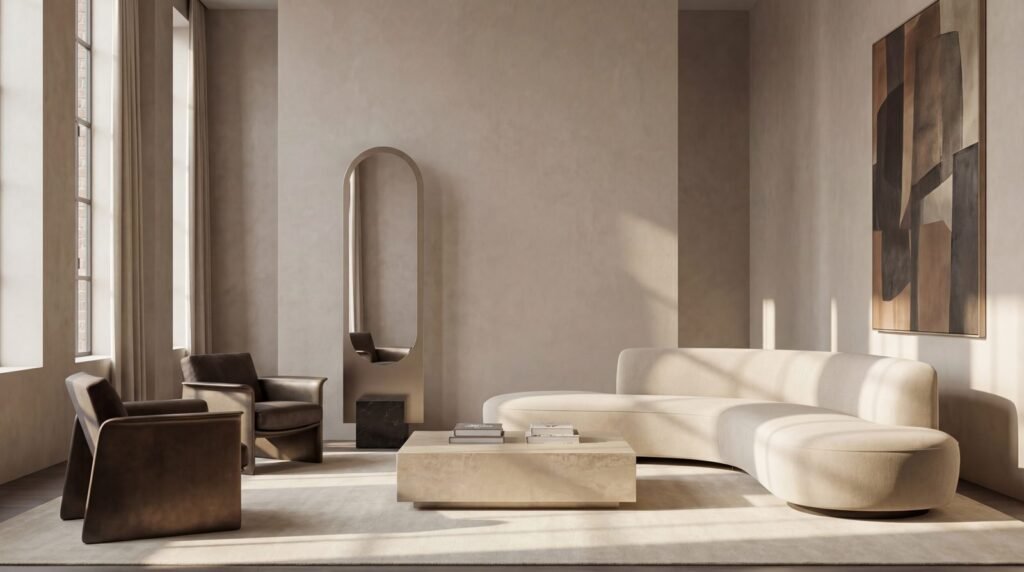
Walk through a gallery-forward loft in Chelsea or a downtown apartment styled by one of the designers defining Manhattan right now, and the furniture is often doing double duty as sculpture. This is not new. What is new is how far the object category has stretched. A decade ago the collectible piece in the room was a chair or a light. Now it can be a mirror that spends most of the day reflecting nothing in particular and simply holding a corner of the floor.
That matters for the kind of interiors we cover most: art-forward Chelsea lofts, prewar apartments with a single dramatic entry, and gallery-like spaces where the owner wants one object to carry a room instead of ten to fill it. A floor mirror that reads as a sculpture answers all three. It works in a foyer where there is no room for furniture. It works in a loft where the eye needs somewhere to land. And it photographs the way collectors want their rooms to photograph.
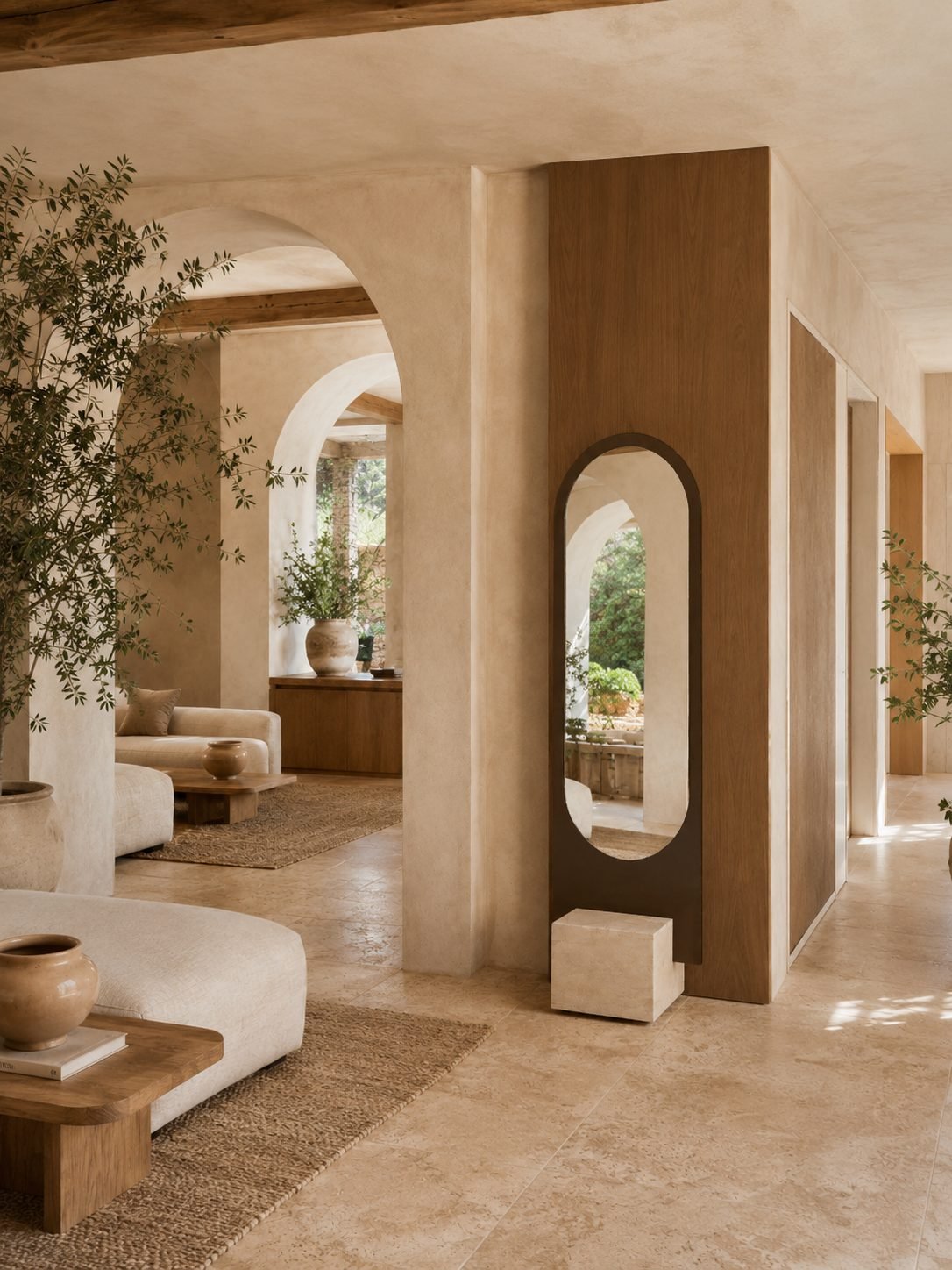
How Alice came together
According to Cosentino’s account, the collaboration started with a conversation rather than a brief. Claris founder Eugene Ishchak met the studio’s creative director and designer, Benoit Gerard, at Cosentino’s C·NEXT event. The dialogue continued at Cosentino City Toronto, where the two introduced “Twins,” an earlier mirror concept that went on to become the creative language of what Claris now calls the Gemini Collection. At C·NEXT 2026 they encountered ĒCLOS, and the base for Alice fell into place.
Gerard frames the intent plainly in the Cosentino piece.
The idea was never simply to create another mirror. It was to create an object where every material contributes equally to the overall composition.
That sentence is the whole design thesis. The glass is not the star with the base as a stand. The base is not a pedestal holding up the real product. Each part carries equal weight, which is exactly how a sculpture behaves and exactly how most manufactured mirrors do not.
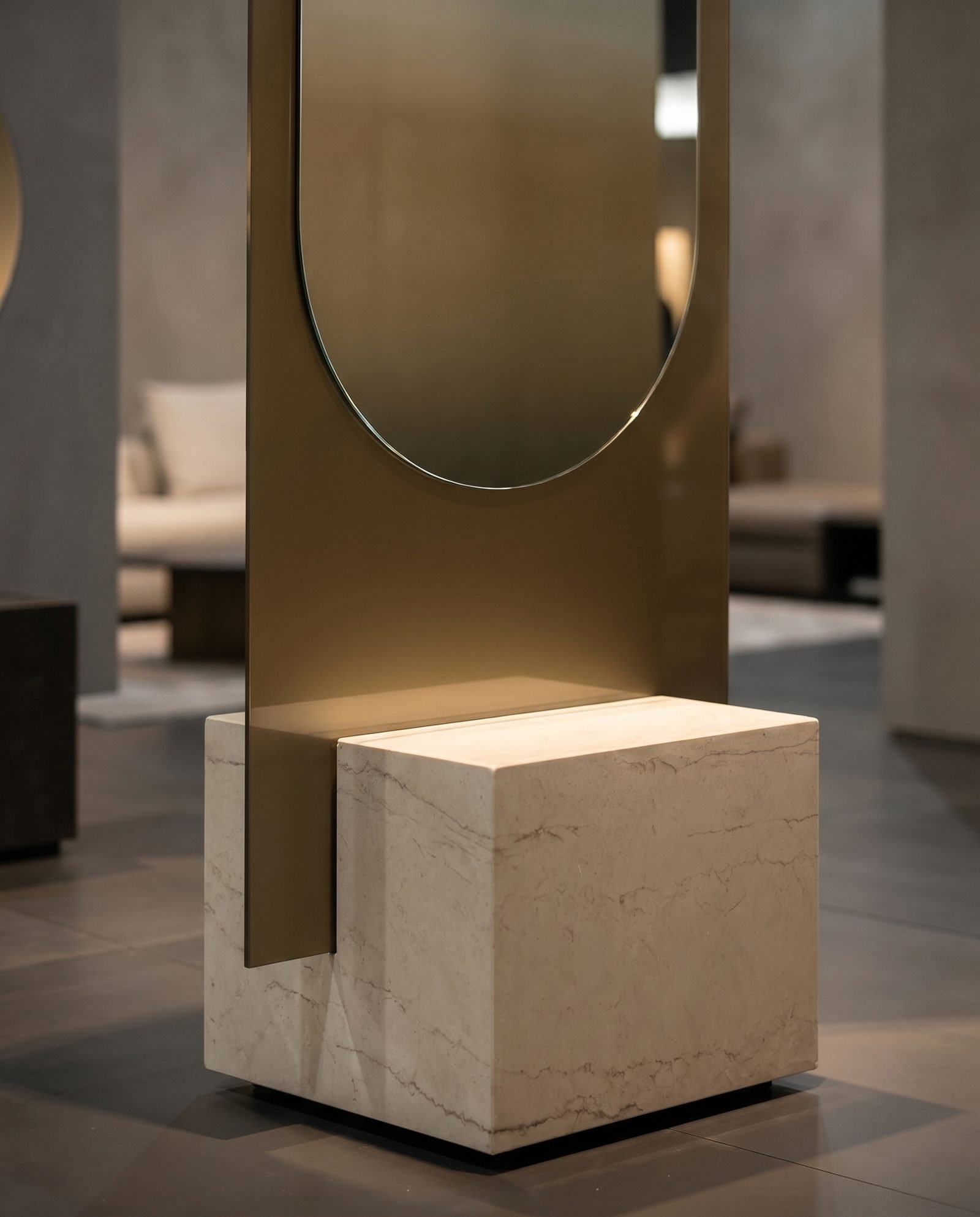
What ĒCLOS actually is
ĒCLOS is a full-body mineral surface with continuous veining, originally developed by Cosentino for architecture. Full-body is the operative term. The veining runs through the entire thickness of the material, so the surface reveals the same natural character across every edge and profile. A fabricator can shape it and expose it from any angle without hitting a printed layer or a plain core that gives the game away.
For a floor sculpture, that property is the point. A base that gets cut, curved, and viewed from all sides needs to look intentional from all sides. A veneered or surface-printed material would break the illusion the moment you walked around it. ĒCLOS holds its character in the round, which is why it can carry the bottom half of an object meant to be seen as one continuous piece.
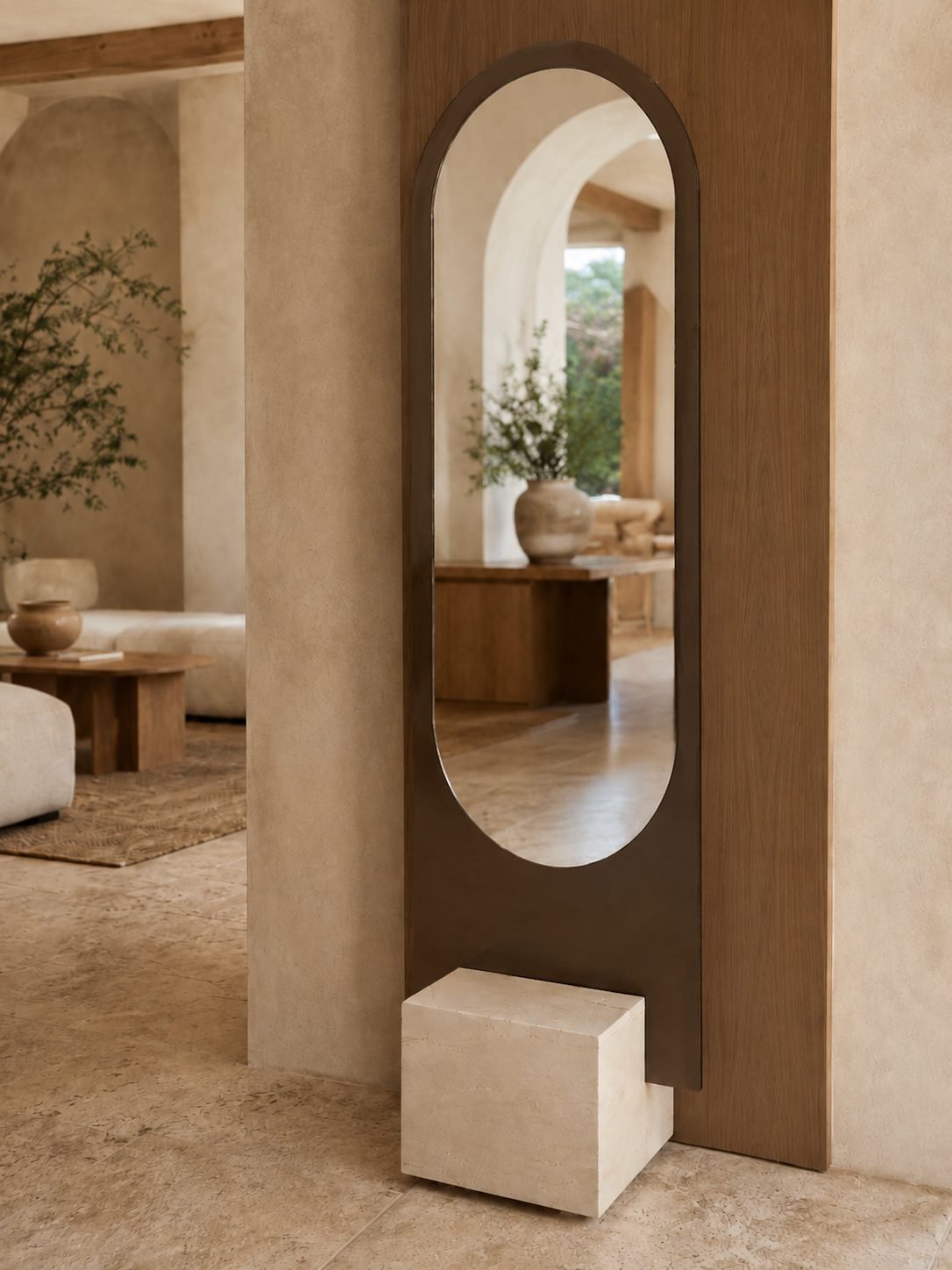
The sculptural mirror as a room’s anchor
Claris describes Alice as a presence that changes with light, movement, and perspective. In practical terms, a sculptural mirror does three jobs at once in a New York apartment. It bounces daylight into deep floor plans, which matters in railroad layouts and interior rooms with one window. It gives a foyer a reason to exist beyond dropping keys. And it reflects the room back at an angle, which reads as depth in tight square footage.
The bronze-frosted glass is doing specific work in that last job. A frosted surface softens the reflection so the mirror registers as an object first and a functional surface second. You notice the thing before you notice yourself, which is the correct order for a sculpture and the wrong order for a vanity. Anyone planning an entry around one should think about it the way they would think about placing a light, a subject we get into in our guide to where to buy lighting in NYC.
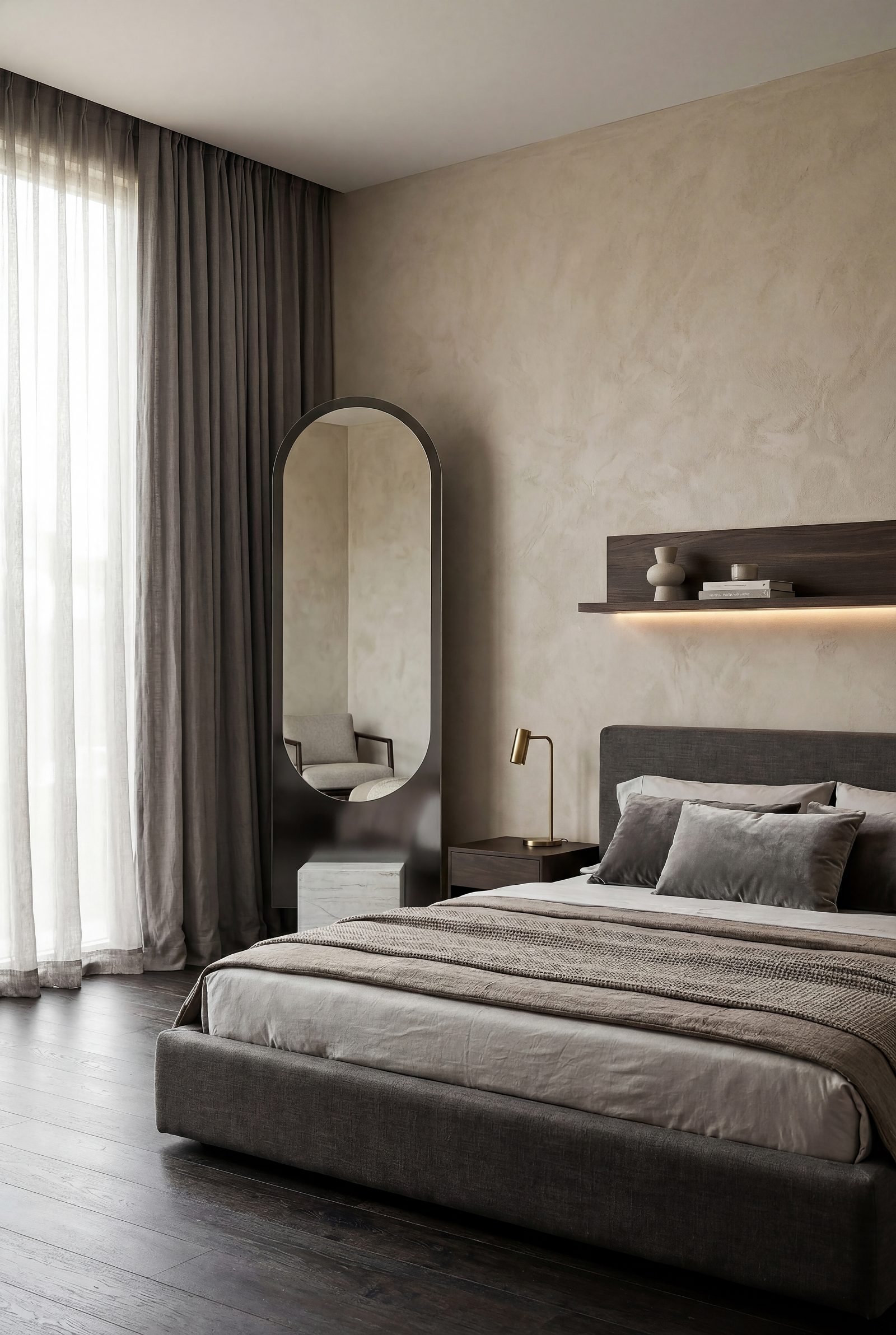
The Gemini range, with prices
Alice sits inside the Gemini Collection, nine mirrors by Gerard that each pair a primary form with a circular aperture. All of them use 6mm bronze-frosted Belgian glass. Claris specifies Diamond ClearVision low-iron glass, crafted in Europe, certified to North American standards, and backed by a five-year warranty. Low-iron matters here for the same reason it matters in any bathroom mirror: it drops the green cast that ordinary glass carries, so color and material read closer to true.
The range spans a wide price ladder, which is the useful part for anyone specifying. Alice, the freestanding floor piece, is $5,000. Alice Mini, a tabletop-scale version built for countertops, shelving, and vanities, is $750 and offers the cheapest way into the look. Both come in two ĒCLOS finishes: Ivora, a warm off-white matte, and Phantome, a deep matte black.
Between those two ends sit the wall pieces. Gigi starts at $1,350, Alhena at $1,700, Twins at $1,800, Leda at $1,900, Jumeau at $2,000, and Mercure at $2,400. The statement piece is Vivo, a triple-aperture design that spans a 76-inch wall and starts at $2,550. For a downtown loft with the wall to spare, Vivo is the one that does the work of a large-scale artwork at a fraction of what large-scale artwork costs.
Where it fits, and where it does not
A sculptural mirror is not a solution for a room that needs storage or seating. It is a solution for a room that needs a focal point and has the floor or wall to give one. That makes it a foyer piece, a loft piece, and a bedroom-corner piece far more often than a living-room-center piece. The floor version wants roughly two feet of clearance on either side so the eye can read it as an object and not as a fixture crammed against a wall.
The broader signal is the one worth holding onto. The mirror has joined the chair, the light, and the vessel as a category where New York buyers will pay for design rather than function. Alice is a clean example of what that looks like when two materials are given equal weight. Whether it belongs in your project comes down to the same question a sculpture always asks: is there a spot in the room that wants an object, and is this the object it wants.
Sources
- Cosentino, “How ĒCLOS Became an Integral Part of Alice and Alice Mini”
- Claris Company, Gemini Collection