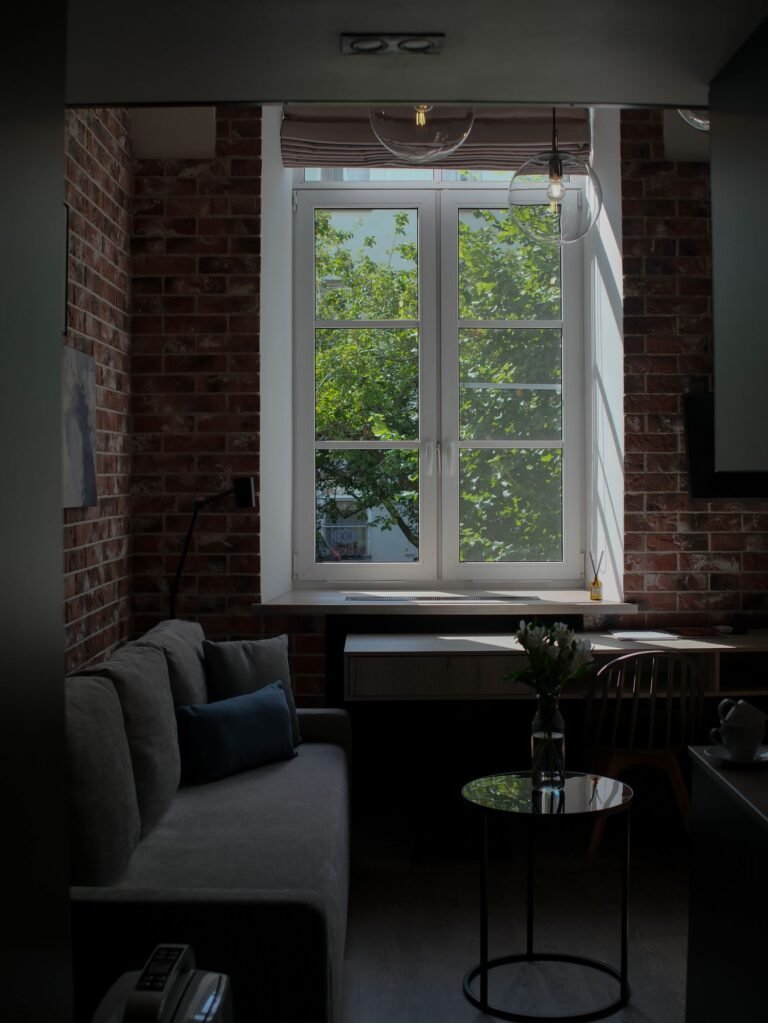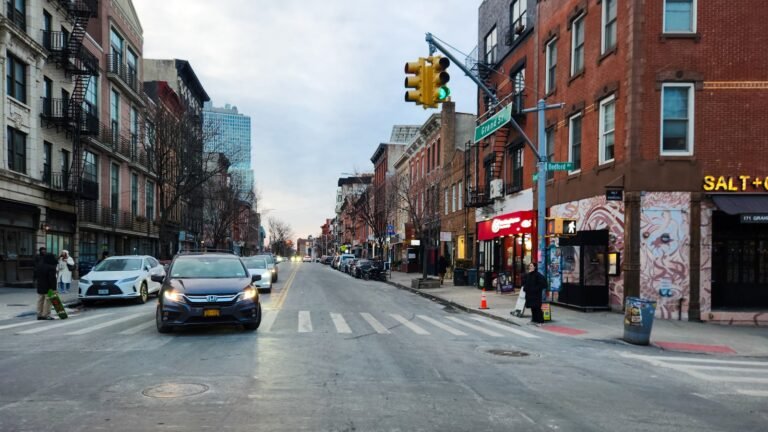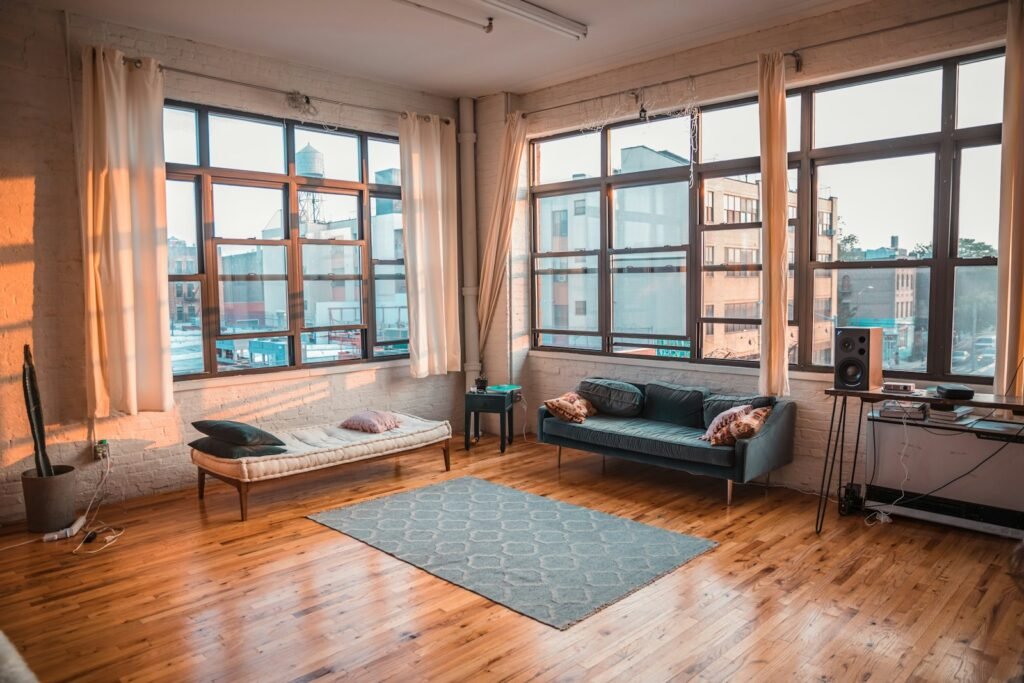
Williamsburg has two kinds of apartments, and they want opposite things from you. Inland, roughly between Berry Street and the BQE, the housing stock runs to brick factory conversions with concrete columns and ceilings that top 12 feet. Along the East River, a wall of glass has gone up, from the towers near North 6th Street down to the old Domino Sugar Refinery site. Williamsburg interior design at its best pairs a raw industrial shell with warm, low-slung modern furniture: post-war wood and steel against brick, soft textiles against concrete. Get the formula right and a loft feels like a home instead of an event space, and a tower unit feels like Brooklyn instead of a hotel lobby in Miami.
This guide covers both building types, the style that grew up around them, the stores still worth your time in 2026, and the decisions that trip people up. It is part of our series of neighborhood design guides.
Key takeaways
- Williamsburg interiors split into two camps: pre-war factory conversions like the Austin Nichols House and post-2008 glass towers along Kent Avenue and the Domino site.
- The prevailing look is an industrial shell with a warm modern fill: post-war furniture, heavy textiles, ceramics, and plants set against brick and concrete.
- Lofts need zoning and acoustic control. Towers need glare control and texture. The two problems call for nearly opposite shopping lists.
- BEAM at 272 Kent Avenue, Mogutable at 130 Grand Street, and Open Air Modern at 489 Lorimer Street anchor the local shopping circuit.
- Retail churns fast here. Home Union, a neighborhood fixture since 2016, now sells online only. Confirm hours before you make the trip.
The architecture: factories first, towers second
Start with the conversions, because they set the neighborhood’s terms. The Austin Nichols House at 184 Kent Avenue was built in 1915 by Cass Gilbert, the architect of the Woolworth Building, as a warehouse for what was then the city’s largest grocery wholesaler. It is an Egyptian Revival block of reinforced concrete, one of the earliest of its kind in the country, and in 2016 it was converted into 338 loft condominiums with 12-foot ceilings and chevron-laid oak floors. A few blocks inland, the Lewis Steel Building on North 4th Street turned a 1930s steel factory into 83 loft rentals, keeping the steel sash windows and original detail. These buildings are why people move here. They are also why so much Williamsburg furniture shopping is really a search for objects that can hold their own against a concrete column.
The towers are the second act. The Domino Sugar Refinery opened in 1882, shut down in 2004, and is now the centerpiece of a redevelopment by Two Trees reported at 2.5 billion dollars, master planned by SHoP Architects with six acres of waterfront park. The landmark refinery itself reopened in 2023 as offices, with a new glass vault built inside the preserved brick shell. Around it stand One South First and Ten Grand, a linked 42-story and 24-story pair by CookFox that opened in 2019, and One Domino Square, Annabelle Selldorf’s first residential tower, clad in iridescent tile that shifts color with the light. Add the earlier generation of glass condos near North 6th Street, The Edge among them, and you have thousands of new units with floor-to-ceiling windows, standard ceiling heights, and finishes chosen to offend no one.
The interior design consequence is simple. A conversion gives you too much character and asks you to organize it. A tower gives you almost none and asks you to supply it.
The Williamsburg look, defined
Call it Brooklyn modern. The shell stays honest: brick is left exposed, concrete is sealed rather than covered, ductwork stays visible. The fill is where the warmth comes in. Post-war American, Italian, and Scandinavian furniture does the heavy lifting, walnut credenzas, low teak sofas, cane-back chairs. Textiles run thick and matte: wool rugs, linen curtains, nubby upholstery. Ceramics and glassware sit out on open shelving because the kitchens rarely have enough closed storage. The palette holds to rust, ochre, olive, and bone against the red of the brick, with black steel as the connective line.
It helps to see what this look is not. It is not the cast-iron grandeur of SoHo loft design, which leans more polished and more gallery-like. And it is not the restored-Victorian language of Park Slope’s brownstones, with their plaster medallions and parlor floors. Williamsburg’s rooms are blunter. The neighborhood defined loft culture for a generation of New Yorkers, and the best interiors here still read as working spaces that someone decided to live in, not living rooms dressed up as studios.

The stores worth knowing
The shopping circuit is compact enough to walk in an afternoon, south to north.
| Store | Address | What it is for |
|---|---|---|
| BEAM | 272 Kent Avenue | New contemporary furniture and lighting: USM Haller, Ferm Living, Nordic Knots rugs, Tekla textiles. Open daily 11 to 7. |
| Mogutable | 130 Grand Street | Japanese tableware and home goods, including Hasami Porcelain and Kinto. |
| Open Air Modern | 489 Lorimer Street | Post-war American, Italian, and Scandinavian furniture and lighting, in business since 2010. By appointment, Tuesday through Friday. |
BEAM, a block from the Austin Nichols House, covers the new half of the formula, and its USM modular pieces are particularly good at standing up to loft proportions. Mogutable on Grand Street handles the open-shelf layer: plates, mugs, and vases that look intentional on display. Open Air Modern on Lorimer Street is the serious vintage stop, with collector-grade post-war pieces, and the appointment system means you should plan ahead rather than wander in.
One caution that doubles as advice: Home Union, the 20th-century design dealer that helped define the neighborhood’s vintage scene after opening in 2016, has given up its storefront and now sells online. Williamsburg retail turns over quickly, and rents keep pushing dealers to warehouses and websites. Check that a store still exists before building a Saturday around it.
Practical decorating notes
For a factory conversion:
- Zone with rugs, not walls. An open 1,200-square-foot loft usually needs three distinct rugs, and the one under the seating area should be 9 by 12 or larger.
- Scale up. Under a 12-foot ceiling, a 78-inch sofa looks like doll furniture. Go past 90 inches and add height with bookcases and tall plants.
- Tame the brick instead of fighting it. Olive, slate, and bone calm the red; piling on more warm tones turns the room orange.
- Buy for your ears. Concrete and brick bounce sound, so wool rugs, full bookshelves, and lined curtains are acoustic equipment, not decoration.
- Plan on plug-in lighting. Ceiling junction boxes are scarce in conversions, and a pair of serious floor lamps beats one weak overhead fixture.
For a glass tower:
- Solve glare first. West-facing river views come with hard afternoon sun, and solar shades do what sheer curtains cannot.
- Float the furniture. Window walls remove your anchor wall, so back the sofa with a console and let the plan sit free of the perimeter.
- Add texture everywhere. Developer finishes are flat by default, so the room needs wood grain, wool, ceramic, and paper to read as lived in.
- Skip the oversized pendant. Ceilings in the towers are standard height, and statement lighting that works in a loft will crowd them.
- Put one true vintage piece in every room. It is the single cheapest way to keep a new unit from reading like the model apartment.
For more on making small and new-construction apartments work, see our city living archive.

Frequently asked questions
What defines Williamsburg interior design?
An honest industrial shell with a warm modern fill. Exposed brick, sealed concrete, and visible steel stay on display, while post-war furniture, thick textiles, ceramics, and plants supply the comfort. The palette favors rust, ochre, olive, and bone with black steel accents.
Are Williamsburg lofts real factory conversions?
Many are. The Austin Nichols House at 184 Kent Avenue is a 1915 Cass Gilbert warehouse converted to 338 lofts, and the Lewis Steel Building on North 4th Street is a converted 1930s steel factory. Plenty of newer buildings borrow the look without the history, so check the building’s construction date, window depth, and ceiling height before paying a conversion premium.
Where should I shop for furniture in Williamsburg?
BEAM at 272 Kent Avenue for new contemporary furniture, Open Air Modern at 489 Lorimer Street for collector-grade post-war vintage by appointment, and Mogutable at 130 Grand Street for Japanese tableware. Several vintage dealers, including Home Union, now operate online only, so verify hours before visiting.
Do Williamsburg lofts and towers need different decorating?
Yes. Lofts need zoning and acoustic control. Towers need glare control and texture. The two problems call for nearly opposite shopping lists.
Sources
- CityRealty: Austin Nichols House, 184 Kent Avenue
- Dezeen: CookFox towers at the Domino Sugar Refinery
- Designboom: The Refinery at Domino completes
- BEAM, Williamsburg
- Open Air Modern
- Mogutable