Buy a front-lit or dual-lit mirror if you shave, tweeze, or do makeup at the sink, because only light aimed at your face works as task light. Buy a backlit mirror if you want the mirror to act as ambient architecture, a quiet halo on the wall, with the real grooming light coming from sconces or the ceiling.
That is the whole decision. Everything past it is detail, and the detail is where people overspend. The two types photograph almost identically in product listings. On a real wall they behave nothing alike. Here is how to tell them apart, which features earn their price, and what you can realistically install in a New York rental versus a renovation.
Key takeaways
- Backlit mirrors aim their LEDs at the wall behind the glass. The result is soft, indirect light that flatters the room and underserves your face.
- Front-lit mirrors aim diffused LED strips at you. That is task light, the kind shaving and makeup actually require.
- Dual-lit mirrors run both circuits, usually with separate controls. If the budget stretches, they settle the argument.
- Size the mirror 2 to 4 inches narrower than the vanity on each side, and never wider than the countertop.
- Anti-fog heating, dimming, and color temperature switching are worth paying for. Bluetooth speakers and digital clocks are not.
- Renters should buy plug-in models. Renovators should hardwire, and in New York City that means a licensed electrician.
How each type actually lights a face
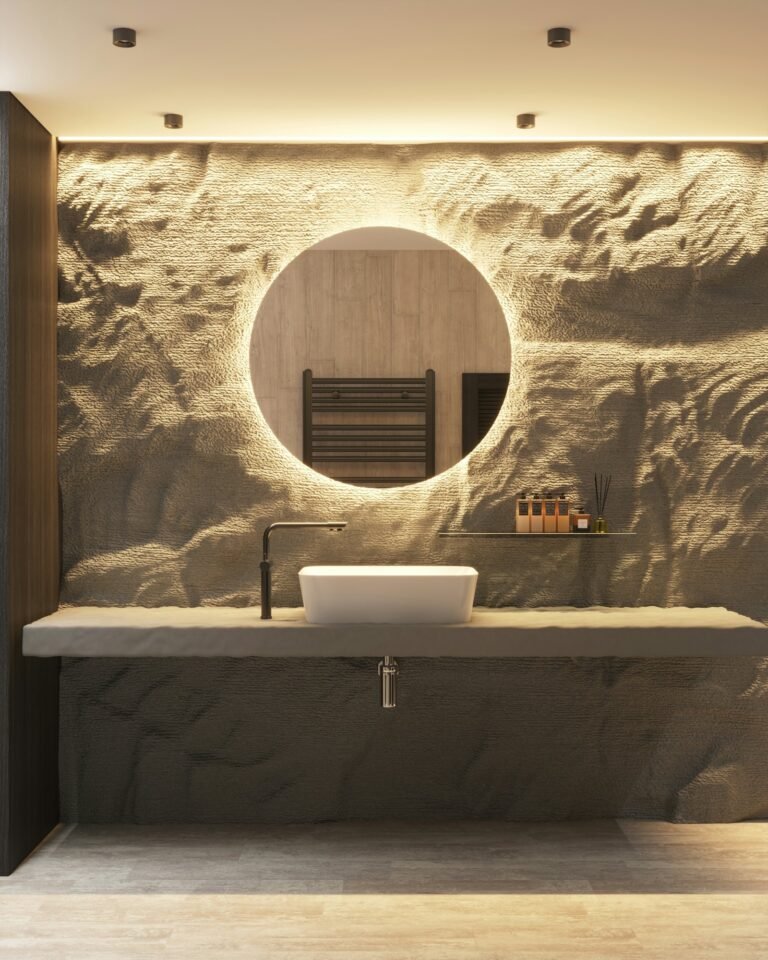
A backlit mirror mounts its LEDs behind the glass, facing the wall. Light escapes around the edges and bounces back into the room. Retail comparison guides such as Plumbworld’s describe the effect as a halo, and that is accurate. The glass appears to float, the wall glows, and the bathroom reads warmer and less clinical. The trade-off is physics. Any light that reaches your face has already bounced off paint, so it arrives diffuse and dim. Stand close and you will find shadows under the brow, the nose, and the chin. Those are exactly the spots where a razor or a makeup brush needs information.
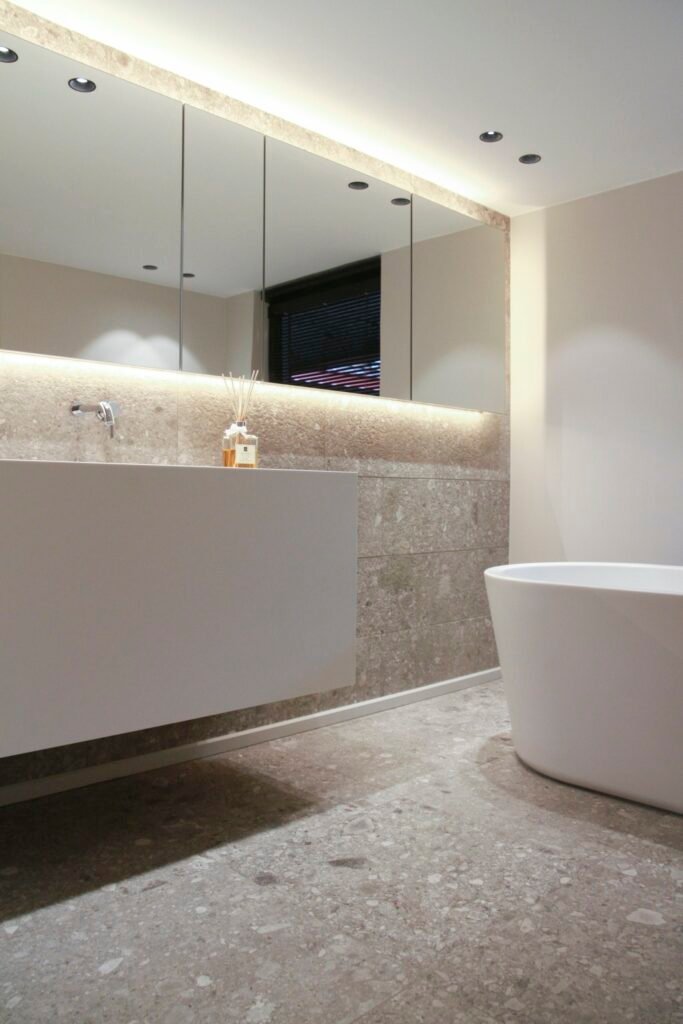
A front-lit mirror does the opposite. Its LEDs sit behind frosted strips or panels on the mirror face, aimed forward. Light hits you directly and evenly, filling shadows instead of casting them. Guides across the category agree on this division of labor: front-lit handles grooming, backlit handles atmosphere.
Dual-lit mirrors carry both circuits and usually let you run them independently. Front light on for a 7 a.m. shave, back light alone for a bath at night. They cost more than either single type, but in a one-bathroom apartment where the mirror is the main light source at the sink, the premium is easy to defend.
| Backlit | Front-lit | Dual-lit | |
|---|---|---|---|
| Light quality | Soft, indirect glow bounced off the wall; gentle on the room, weak on the face | Direct, even illumination aimed at the user; minimal facial shadows | Both, usually on separate switches or touch controls |
| Best for | Powder rooms, second bathrooms, spaces with good sconce or ceiling light | Primary bathrooms where shaving and makeup happen at the mirror | One-bathroom apartments; anyone unwilling to compromise |
| Install notes | Needs 1 to 2 inches of depth off the wall for the glow to register; check projection specs | Flattest profiles available; light strips do the work, so wall color matters less | Higher wattage and more controls; confirm plug-in vs hardwired before buying |
Sizing and placement
The standard designer rule holds for lighted mirrors: keep the mirror 2 to 4 inches narrower than the vanity on each side, which means 4 to 8 inches less than the total countertop width. A 36-inch vanity takes a 28-to-32-inch mirror; a 48-inch vanity takes 40 to 44 inches. Sizing references like Omni Calculator’s bathroom mirror guide repeat the same proportions, and the second half of the rule matters more than the first: a mirror should never be wider than the countertop below it. It looks unanchored, and a backlit halo bleeding past the vanity edge makes the error glow.
For height, center the mirror at eye level for the people who use the sink daily, with the bottom edge a few inches above the faucet’s splash line. In a small bathroom, an illuminated mirror can replace a sconce entirely and free up wall space, one of the easier wins we cover in our small apartment ideas guide.

The features worth paying for, and the ones that are not
Anti-fog heating. Worth it, and at this point it should be treated as standard rather than an upgrade. The mechanism is a demister pad, a thin heating film behind the glass that warms the surface to roughly 104°F (40°C), just enough that shower steam never condenses on it. WarmlyYours explains the science plainly: fog is condensation on cool glass, so keep the glass slightly warmer than the air and there is nothing to wipe. Typical pads draw 20 to 50 watts and only while switched on.
Dimming and color temperature switching. Also worth it. Most adjustable mirrors cycle between roughly 2700K warm white, 4000K neutral, and 6000K cool daylight. Neutral light in the 4000K range shows skin and makeup most honestly, warm suits an evening bath, and cool picks out fine hairs for shaving. Look for a memory function that holds your last setting, a Color Rendering Index of 90 or above, and enough output to matter. The American Lighting Association’s guidance, cited in RP Lighting’s vanity guide, puts the vanity minimum at 1,600 lumens.
A real moisture rating. Any mirror mounted above a sink should carry at least an IP44 rating, which certifies protection against splashing water from any direction. Mullan Lighting’s IP rating explainer breaks down the code; the short version is that IP44 covers sink spray and steam, and anything unrated has no business in a bathroom.
Skip the rest. Built-in Bluetooth speakers sound thin and fail before the LEDs do. Digital clocks date the glass the way a microwave clock dates a kitchen. Color-cycling RGB modes belong in a dorm. Every dollar spent on those is a dollar not spent on light quality, and light quality is the entire point. We pressure-test these claims model by model in our reviews.
Renting vs renovating: the install reality
If you rent, buy a plug-in mirror. It hangs like any heavy mirror, the cord runs to an existing outlet, and the whole thing leaves with you at the end of the lease. The compromises are a visible cord and a dependency on outlet placement. Code requires receptacles near sinks to be GFCI protected, the kind with the test and reset buttons, and most apartment bathrooms have exactly one. If yours sits far from the vanity, measure the cord before you buy.
If you are renovating, hardwire. The mirror connects to a junction box hidden behind it, there is no cord, and the result is the clean wall that makes these mirrors look built-in rather than bought. In New York City that is not a weekend project: the Department of Buildings requires electrical work to be performed by a licensed electrician, and new wiring generally needs a permit. Fold the cost into the larger job. Our NYC bathroom renovation cost breakdown covers where electrical labor lands in the budget, and our renovation guides cover the rest of the sequence.

Frequently asked questions
Is a backlit bathroom mirror bright enough for makeup?
On its own, usually not. Backlit light reaches your face secondhand, after bouncing off the wall, so it flattens detail and leaves shadows under the brow and chin. Pair a backlit mirror with sconces or strong ceiling light, or choose a front-lit or dual-lit model if the mirror must carry the task lighting by itself.
Do lighted mirrors need a special outlet?
Plug-in models need a standard GFCI-protected receptacle, which bathroom code already requires near sinks. Hardwired models need a junction box behind the mirror instead of an outlet. The fixture itself draws little power; LED strips plus an anti-fog pad typically total well under 100 watts.
Can I install a lighted mirror in a rental?
Yes, if it is plug-in. Hanging one is no different from hanging any heavy mirror, and it comes down without a trace beyond anchor holes. Hardwired models are off the table in a rental: in New York City, electrical work legally requires a licensed electrician, and your landlord’s sign-off besides.
What size should a lighted bathroom mirror be?
Size the mirror 2 to 4 inches narrower than the vanity on each side, and never wider than the countertop.
Sources
- Plumbworld: Backlit vs Front-Lit Mirrors, What’s the Difference?
- WarmlyYours: How Mirror Defoggers Work
- RP Lighting + Fans: A Guide to Choosing the Right Vanity Lighting
- Mullan Lighting: IP Rating of Light Fixtures Explained
- Omni Calculator: Bathroom Mirror Size
- NYC Department of Buildings: Electrical Permits