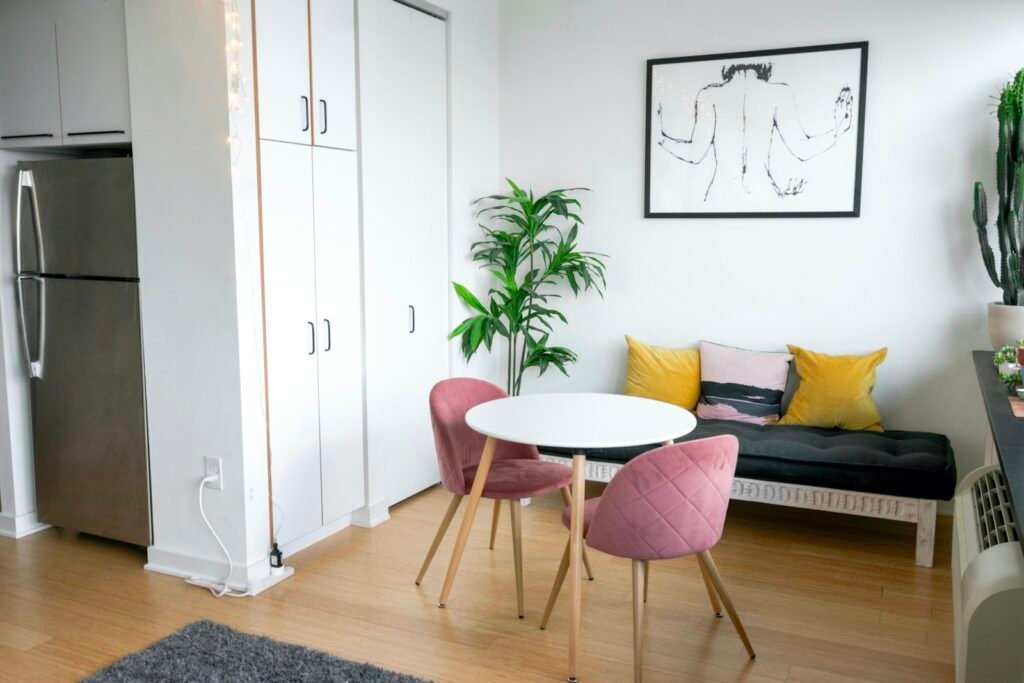
New York is the national test lab for small apartment ideas. The typical Manhattan studio runs around 550 square feet, and thousands of renters live in far less. Watch enough designers work inside these floor plans and one lesson repeats: zone the space first, then size the furniture to the zone, not to the room. Every other trick, the ceiling-height curtains, the storage bed, the mirror across from the window, works harder once each square foot has an assigned job.
The ideas below hold up in real 300 to 700 square foot homes, and they come with the numbers designers work from: rug dimensions, sofa depths, walkway clearances, mounting heights. The ideas travel anywhere. The proof is New York.
To see these principles inside specific buildings, browse our City Living coverage, including the small prewar apartments of the West Village, where 600 square feet with nine foot ceilings is the standard deal.
Key takeaways
- Zone before you buy. A rug, an open bookcase, and a dedicated lamp can carve a living room, an office, and a bedroom out of one studio.
- In a small living room, the rug should be bigger than instinct says: 8×10 in most rooms, front legs of every seat resting on it.
- Choose an apartment-scale sofa: 72 to 80 inches long, 32 to 35 inches deep, on raised legs.
- Storage goes up, not out: shelving to within a foot of the ceiling, hooks on workable walls, a bed with drawers underneath.
- Give every zone its own light source and retire the single overhead bulb. Three layers of light per room is the working rule.
- The fastest ways to shrink a room: a tiny rug, furniture shoved against every wall, curtains hung at window height, and clutter smaller than a grapefruit.
Zoning a studio: rugs, shelving, and light
A studio fails when it reads as one room with a bed in it. It works when it reads as three small rooms that happen to share air. Designers build that separation with three tools, no contractor required.
Rugs draw the floor plan. Give each zone its own: a 5×8 or 6×9 under the sofa and coffee table, a runner along the open side of the bed, bare floor or a flat-weave mat under the desk or dining table. Keep the palettes related so the zones read as chapters of one apartment.
Shelving stands in for walls. An open-backed bookcase around six feet tall, set perpendicular to the wall between sofa and bed, blocks the sightline at seated height while letting light pass. The polished version: in a 680 square foot West Village renovation featured by Remodelista, the architects organized the whole apartment around three freestanding white oak millwork volumes holding closets, deep storage, shelves, and a desk. Divider and storage occupy the same footprint, which is the entire trick.
Light finishes the job. The lighting professionals interviewed by Real Homes push back hardest on the single overhead fixture, which flattens a small space and throws harsh shadows. Give each zone its own switchable source: a floor lamp at the sofa, a sconce or clamp lamp at the bed, a task lamp at the desk. Turn one off and that zone disappears, which is exactly what you want at 11 p.m. when the bedroom needs to exist and the living room does not.
Small apartment living room ideas that respect scale
The living room takes the most abuse in a small apartment because it holds the most jobs: TV room, guest room, office, dining room. The scale rules below keep it from collapsing into a furniture parking lot.
Start with the rug, and go bigger than feels safe. An 8×10 with the front legs of the sofa and chairs on it unifies the seating into one object and makes the floor read as a single plane. The rug should run 6 to 8 inches past the sofa on each side, with 12 to 18 inches of bare floor left at the room’s edges. A 5×7 floating mid-room chops the floor and leaves every piece looking marooned.
On the sofa, depth matters more than length. Standard sofas run 38 to 40 inches deep; apartment-depth sofas run 32 to 35, and the saved inches multiply across the sofa’s full length. Look for 72 to 80 inches long, raised legs that show floor underneath, a tight back instead of loose cushions, and slim track arms. That package seats three. Skip the bulky sectional unless it replaces every other seat in the room.
| Measurement | Target | Why it works |
|---|---|---|
| Living room rug | 8×10 ft (6×9 minimum) | Front legs of all seating rest on it; the floor reads as one plane |
| Sofa depth | 32 to 35 in | Saves 5 or more inches of floor versus a standard sofa |
| Sofa length | 72 to 80 in | Seats three without sectional bulk |
| Walkways | 30 to 36 in main paths, 18 in minor | A room feels bigger when you never turn sideways in it |
| Coffee table gap | 14 to 18 in from sofa | Reachable without pinching knees |
| Curtain rod height | Within 2 to 4 in of ceiling | Pulls the eye up and stretches the wall |
Then send storage up the walls. One full wall of shelving, 10 to 12 inches deep and run to within a foot of the ceiling, holds more than a dresser and a media console combined while drawing the eye upward. Hang the curtain rod just below the ceiling with panels that touch the floor. Keep most furniture below about 34 inches and let one tall piece, the shelf wall, anchor the room.

The sleeping area
The bed is the biggest object you own. A queen is 60 by 80 inches, about 33 square feet, a tenth of a 330 square foot studio. Make it earn the space back. A platform bed with built-in drawers replaces a dresser outright; a hydraulic lift-up frame turns the whole footprint under the mattress into a trunk. Either beats loose bins under a frame, because drawers stay usable when you are tired, and bins do not.
Skip the nightstands. A wall-mounted sconce plus a 12 inch floating shelf at mattress height does the same work on zero floor. Need more surface? Choose a headboard with a built-in ledge.
Finally, screen the bed from the entry sightline with the bookcase divider, a ceiling-track curtain, or simple placement. In the 300 square foot New York studios Apartment Therapy tours, one move recurs: bed at the window wall, seating nearest the door, so a guest sees a sofa first, not a mattress.
The kitchen and the entry
New York galley kitchens can run as little as 30 square feet, so the working rule is that nothing flat stays empty. A magnetic knife strip and a rail with S-hooks clear the counter. Shelf risers double each cabinet’s capacity. Cabinet tops take the once-a-year equipment in matching bins. A rolling cart, roughly 20 by 16 inches, works as pantry and prep station and parks beside the fridge.
Most small apartments have no real entry, so build one in six square feet: a row of hooks mounted at 60 to 66 inches, a console less than 12 inches deep or a wall-mounted shelf, a tray for keys, and a mirror above it for light and the last check on the way out.
If you own and can open walls, pass-throughs and built-ins change the math; our renovation guides cover those projects in New York buildings. Renters comparing layouts can see typical floor plans across the city in our neighborhood profiles.

What to skip: the mistakes that shrink rooms
- The postage-stamp rug. A small rug adrift in bare floor is the fastest way to make a room read smaller than it is. Size up or go bare.
- The wall-hugger layout. Designers interviewed by Apartment Therapy repeat this one: furniture tight to the baseboards traces the room’s true size. Pull pieces a few inches off the wall; the shadow gap reads as depth.
- Low curtains. A rod mounted at the window frame drags the ceiling down. Mount near the ceiling, hem at the floor.
- Tiny clutter. The grapefruit rule, cited in the same Apartment Therapy reporting: any decorative object smaller than a grapefruit reads as visual static. Group little things on one tray or cut them.
- Too many small pieces. Designers quoted by Bob Vila flag undersized furniture as a shrinking agent too: six small pieces read busier than three properly scaled ones.
- One overhead bulb. Flat light makes a small room feel like a waiting room. Three sources, three heights.
Frequently asked questions
How do you decorate a small apartment so it feels bigger?
Set the zones first, then decorate each one as a small room. Use one oversized rug per zone, hang curtains near the ceiling, keep most furniture below 34 inches with a single tall anchor piece, run three light sources per room, and edit out objects smaller than a grapefruit. A unified palette, or one deep wall color, beats a timid all-white box.
What size rug works in a small living room?
An 8×10 in most rooms, a 6×9 at minimum. The front legs of the sofa and every chair should rest on it, the rug should extend 6 to 8 inches past the sofa on each side, and 12 to 18 inches of floor should stay bare at the edges. Too small is the common error.
Can 300 square feet hold a real sofa and a real bed?
Yes. New Yorkers prove it daily. A 75 inch apartment-depth sofa takes about 17 square feet, a queen storage bed about 33, a six foot bookcase divider about 4. That is 54 square feet of furniture in a 300 square foot room, which leaves real walkways if the zones are planned first.
How do you divide a studio apartment into zones?
Zone before you buy. A rug, an open bookcase, and a dedicated lamp can carve a living room, an office, and a bedroom out of one studio. Give every zone its own light source; three layers of light per room is the working rule.
Sources
- Apartment Therapy: The Biggest Decorating Mistakes Making Your Space Look Smaller
- Bob Vila: Designers Explain 6 Decorating Mistakes That Can Make a Room Feel Smaller
- Remodelista: A Clever Makeover for a 680-Square-Foot West Village Apartment
- Real Homes: How to Light a Small Apartment, According to the Pros
- Apartment Therapy: Tour a Clever and Uncluttered 300-Square-Foot NYC Studio
- Never Too Small: How to Create Zones in Your Small Living Room
Go deeper room by room: small apartment living room ideas, storage ideas, and kitchen ideas.