Most vanity lighting fails for one reason: the light comes from the wrong direction. Light the face from both sides at eye level, not from above. That single rule removes the shadows under the eyes, nose, and chin that make morning grooming harder than it needs to be. In practice it means a pair of sconces flanking the mirror, centered roughly 60 to 66 inches above the floor, the placement that sizing guides from LightsOnline and Edward Martin both land on.
Everything else in this guide supports that rule. Color temperature, CRI, lumens, and moisture ratings decide how good the light is once it reaches your face. Placement decides where the shadows fall. Get placement right first.
This is a criteria-driven guide, not a brand list. The geometry and the spec thresholds below apply to a $60 sconce from a big-box store and a $600 one from a Brooklyn maker alike. For more independent guides like this one, browse our Reviews section.
Key takeaways
- Mount sconces so the fixture center sits 60 to 66 inches above the floor, spaced 36 to 40 inches apart across the mirror.
- If sconces are impossible, run a bar above the mirror at 75 to 80 percent of the mirror’s width, with the fixture center 75 to 80 inches off the floor.
- Buy 2700K to 3000K for home bathrooms and keep every fixture near the mirror at the same color temperature.
- Insist on CRI 90 or higher. Below 90, skin tones and makeup colors shift.
- Target roughly 1,500 to 2,000 total lumens at the vanity in a small bathroom, on a dimmer, with a UL damp rating on every fixture.
Why overhead-only lighting fails
A single ceiling fixture, or the builder-grade strip mounted high above the mirror, throws light down across your face. The brow shades the eyes. The nose shades the lip. The chin shades the neck. Designers call the result raccoon eyes, and no bulb upgrade can fix it, because the problem is geometry, not output.
This Old House’s bathroom lighting guidance makes the same point: cross light from the sides of the mirror is what removes facial shadows, while light from directly overhead exaggerates them. Houzz’s vanity lighting guide reaches the same conclusion and recommends a pair of fixtures at face height as the default.
Overhead light still has a job. It fills the room, lights the floor and the shower, and reads well in photos. Keep it as the ambient layer. Just never let it be the only layer.
The three placements that work
Flanking sconces, the default
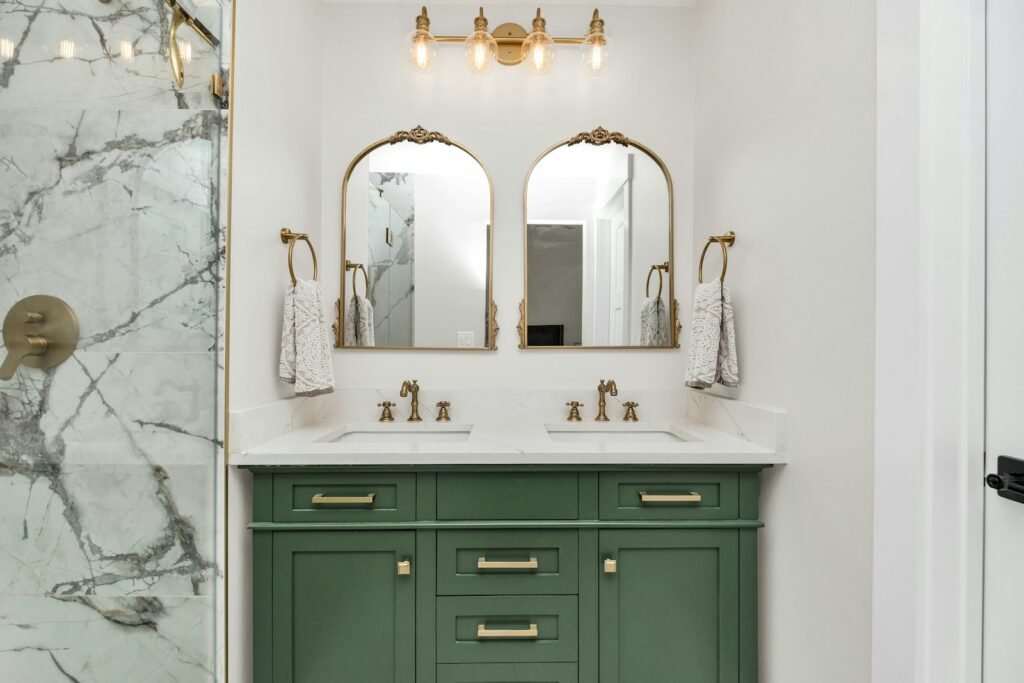
Two sconces, one on each side of the mirror, centered 60 to 66 inches above the finished floor. That puts the source at eye level for most adults, which is the whole point: light at eye level crosses the face evenly instead of raking down it. Space the pair 36 to 40 inches apart for a standard single vanity. In a tight powder room you can pull them in to 28 to 30 inches without losing the effect.
Pick shades that diffuse. Frosted glass, linen, or opal glass spreads light across the face. Clear glass with an exposed filament bulb photographs well and produces glare at the mirror. If you are taller or shorter than average, cheat the height to your own eye level. The number serves the rule, not the other way around.
The over-mirror bar, done right
Sometimes side sconces are impossible. A wall-to-wall mirror, a medicine cabinet flanked by tile, a junction box that sits dead center above the sink. A horizontal bar above the mirror can still work if you size and mount it correctly. Width: 75 to 80 percent of the mirror’s width. Height: fixture center 75 to 80 inches off the floor, or about 3 to 6 inches above the mirror’s top edge.
Choose a bar with a diffused shade that pushes light down and out, not a row of bare bulbs aimed at the ceiling. A long bar mounted at the right height softens the downward angle enough that shadows shrink to tolerable. It will never match cross light, but done right it takes a clear second place.
Backlit and lighted mirrors, the category to watch
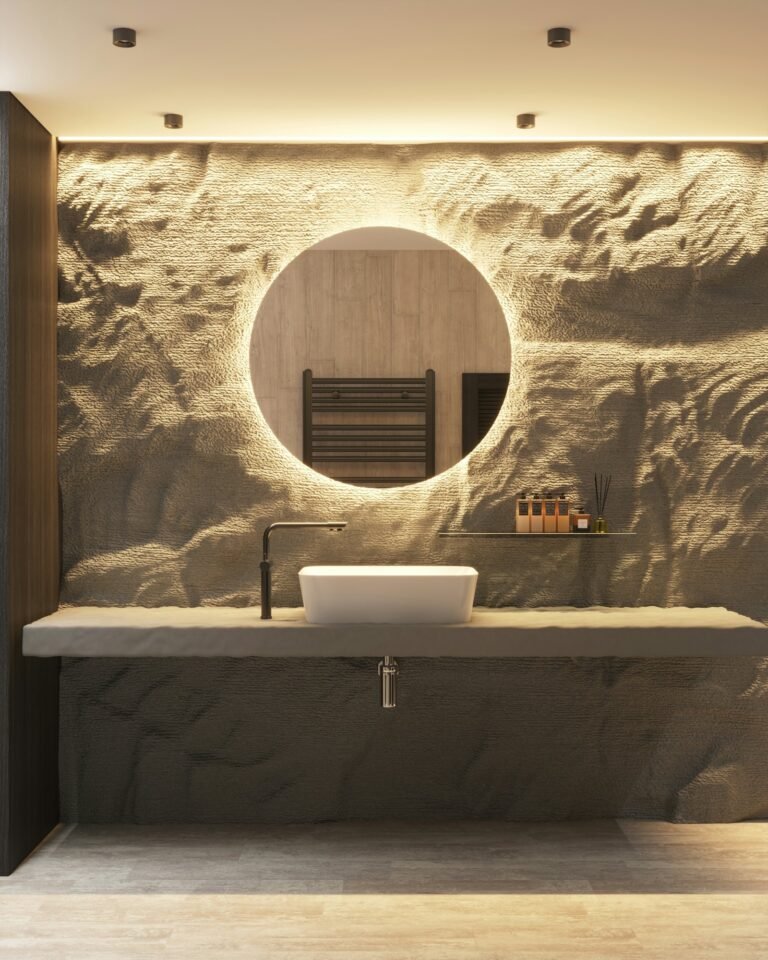
Lighted mirrors put the source at the glass itself, either behind the mirror (backlit) or in a frosted band on its face (front-lit). Treated as a category rather than a brand decision, they solve the geometry problem well. Front-lit models in particular wash the face in even, shadow-free light at exactly the right height.
Buy on specs. Look for a published lumen figure, not just wattage. Adjustable color temperature that includes a 2700K to 3000K setting. CRI 90 or higher stated on the spec sheet. A UL damp rating. Then ask two questions before checkout: is the LED driver replaceable, and how long is the electronics warranty? An integrated strip that fails out of warranty usually means replacing the whole mirror.
One honest caveat: a lighted mirror is task lighting only. It will not fill the room. Plan an ambient layer alongside it.

The numbers that matter
Print this part. The American Lighting Association’s guidance, cited across trade buying guides including the Lumens vanity lighting guide, puts the vanity target near 1,600 lumens; small-bath guides translate that to 1,500 to 2,000 lumens total at the mirror, on a dimmer.
| Spec | The number |
|---|---|
| Sconce mounting height | 60 to 66 inches, floor to fixture center |
| Sconce spacing | 36 to 40 inches apart; 28 to 30 in tight rooms |
| Over-mirror bar width | 75 to 80 percent of mirror width |
| Over-mirror bar height | 75 to 80 inches to fixture center, or 3 to 6 inches above the mirror |
| Color temperature | 2700K to 3000K, matched across fixtures |
| CRI | 90 minimum, 95 if color-critical |
| Total vanity lumens | 1,500 to 2,000 in a small bath, dimmable |
| Moisture rating | UL damp at the vanity; UL wet inside the shower |
The moisture line is not optional. A vanity fixture lives in steam, so UL damp is the floor, and anything inside a shower enclosure must carry a wet rating, per the UL location definitions summarized by Dutton Brown.
What to choose for your bathroom
The prewar small bath
Most prewar baths in New York give you one switched junction box above the mirror and not much wall on either side. Fighting that wiring gets expensive fast, and co-op alteration agreements often require a licensed electrician plus board sign-off before anyone cuts a new box. Work with the box you have: an over-mirror bar at 75 to 80 percent of mirror width, frosted shade, 2700K to 3000K, CRI 90 or higher. If the budget allows, a hardwired front-lit mirror on that same circuit beats any bar. For the larger picture on working inside older buildings, see our guide to apartment renovation in NYC.
The rental
You cannot rewire, but three moves need no electrician. First, fix the bulbs in whatever fixture exists: 2700K to 3000K, CRI 90 or higher, around 800 lumens per bulb. That alone corrects the color. Second, swap the fixture itself. A like-for-like vanity light swap is a change most landlords allow, and the original goes in a closet until move-out. Third, add plug-in sconces with cord covers on either side of the mirror at the 60 to 66 inch line. Renters get the rule too.
The full renovation
If the walls are open, rough in two sconce boxes at 60 to 66 inches, spaced for the mirror you actually plan to hang, and put the vanity circuit on a dimmer. The marginal cost of a second box while the electrician is already on site is small. Vanity lighting is a rounding error inside the figures in our bathroom renovation cost guide for NYC, so spend the savings on fixture quality: real diffusing shades, a published CRI, a damp rating on the label. More planning checklists live in our renovation guides.

Frequently asked questions
How high should vanity lighting be mounted?
Side sconces: 60 to 66 inches from the finished floor to the fixture center, which is eye level for most adults. Over-mirror fixtures: 75 to 80 inches to the fixture center, or about 3 to 6 inches above the mirror’s top edge. Adjust to the eye level of the people who actually use the bathroom.
What color temperature is best for vanity lighting?
2700K to 3000K for most homes. It is warm enough to flatter skin and neutral enough to read color correctly when paired with CRI 90 or higher. Makeup professionals sometimes prefer 3500K to 4000K for color-critical work; if that is you, buy an adjustable-temperature fixture rather than committing the whole room to cool light.
Do lighted mirrors replace vanity lights?
They replace the task layer, not the room’s light. A good front-lit mirror gives even, shadow-free light at the face, which is the job sconces normally do. It does not light the floor, the shower, or the corners, so keep a ceiling fixture or add one. In a small bathroom, a lighted mirror plus one ambient source is a complete plan.
How many lumens do you need for vanity lighting?
Target roughly 1,500 to 2,000 total lumens at the vanity in a small bathroom, on a dimmer. Insist on CRI 90 or higher, because below 90, skin tones and makeup colors shift.
Sources
- This Old House, “A Lesson in Bathroom Lighting”
- Houzz, “How to Choose Your Bathroom Vanity Lighting”
- Lumens, “Best Bathroom Vanity Lighting: Placement, Brightness and Style”
- Edward Martin, “How High Should Bathroom Sconces Be Mounted?”
- LightsOnline, “The Complete Bath Light Sizing Guide”
- Dutton Brown, “Dry, Damp, and Wet Location Lighting”