New York runs its design experiments in restaurants. An apartment takes years to renovate and a decade to photograph. A dining room opens in months, gets shot from every angle by opening week, and either shifts how people think about interiors or disappears. The current crop teaches one clear lesson. A restaurant interior works when the light is low and layered, the seating holds you comfortably for three hours, and the materials look better after five years of wear. Those are home renovation rules too.
Six rooms define the city right now: La Tête d’Or and Coqodaq near Madison Square Park, Brass in NoMad, The Otter in SoHo, Hawksmoor in Gramercy, and Ci Siamo at Manhattan West. Each is open, booked, and built by a firm with a traceable point of view. We follow the category week to week in Hospitality and track the firms behind these projects in Design Scene. This piece pulls the six rooms apart for a different reader: the renovator who wants a dining room that behaves like a great restaurant.
Key takeaways
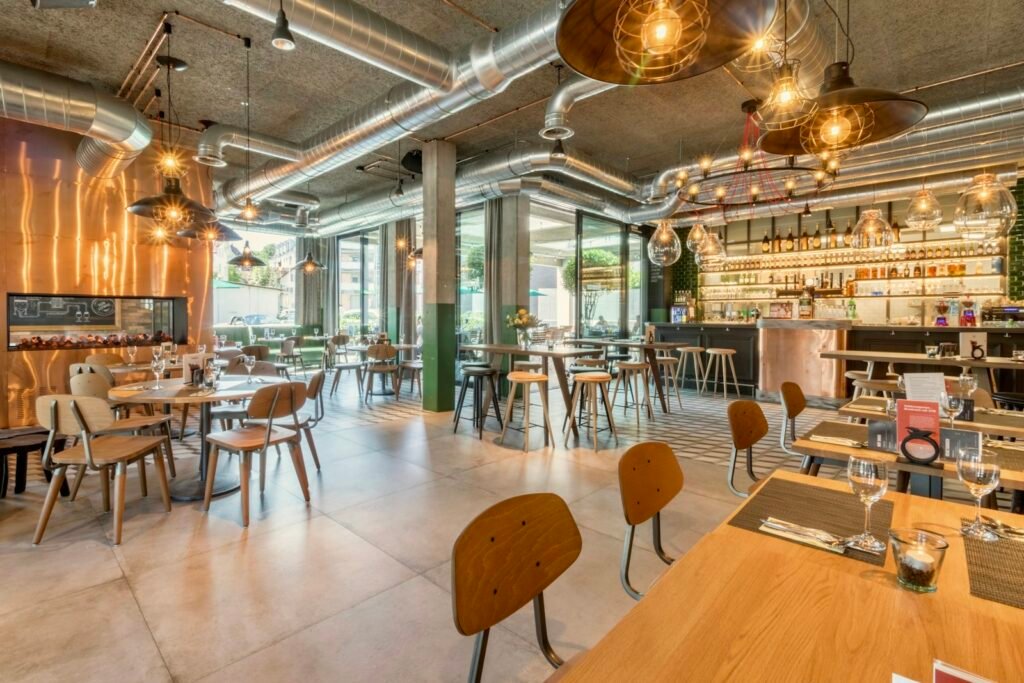
- Lighting carries every room on this list. It is warm, dim, and layered at ceiling, wall, and table height. None of these rooms relies on a single overhead source.
- Ceilings are the new feature wall. Coqodaq built glowing arches, Hawksmoor restored coffered vaults, and Brass organized its dining room under a skylight.
- Banquettes appear in all six rooms. Bench seating is denser and more comfortable than loose chairs, and it translates directly to apartments.
- The same materials repeat: walnut, leather, bronze, stone, glazed tile. Everything wears in instead of wearing out.
- Each room commits to one idea and executes it on every surface. That discipline is the most transferable move of all.
Six rooms that define NYC restaurant design right now
La Tête d’Or, Flatiron
Daniel Boulud’s steakhouse occupies the ground floor of One Madison Avenue, facing Madison Square Park. Rockwell Group designed it as an Art Deco brasserie in deep reds and blues, with dark marble, leather and wood paneling, and mirrored surfaces that double every candle. Lighting came from L’Observatoire International. Above the open kitchen hangs a sculptural hood developed from a collage by Belgian artist Jesse Willems, a nod to the patterned metalwork of Rockefeller Center. The room is grand, but the moves are copyable: saturated wall color, warm metal, mirror placed to bounce light around the room rather than to check hair. The home lesson is that dark rooms fail when lit from one ceiling point. They succeed when small warm sources repeat across the space and reflective surfaces multiply them.
Coqodaq, Flatiron
Simon Kim’s Korean fried chicken restaurant is Rockwell Group again, in a different register. A central aisle runs under a procession of arches made of lit cast glass and bronze, so the architecture itself is the light fixture. The palette is hunter green leather, dark walnut, and soapstone, chosen to take a nightly beating. A marble sink room lets guests wash up before eating with their hands, practical theater that doubles as design. Dezeen called the room a cathedral of fried chicken, which is accurate. The home lesson: spend on the ceiling plane. A cove with a dimmable warm LED strip costs a fraction of a furniture budget and changes a room more than any sofa will.
Brass, NoMad
Brass sits on the ground floor of the Evelyn Hotel, a 1905 Beaux-Arts building on what was once Tin Pan Alley. Islyn Studio, led by Ashley Wilkins, shaped the 70-seat dining room around an antique piano placed under the skylight, a reference to the music publishers who once worked the block. Frescoes by California artist Jessalyn Brooks run across the walls. Wilkins has said the goal was a room that feels already woven into New York, and the 2025 Restaurant and Bar Design Awards shortlist took notice. The home lesson is the anchor object. One real antique with scale and a history organizes a room the way that piano organizes Brass. Buy one old thing, then build the room around it.
The Otter, SoHo
The Otter is the seafood restaurant inside The Manner, Standard International’s hotel on Thompson Street, with interiors by Milan-based architect Hannes Peer. The room is maximalist: saturated color, splashy murals, and glossy finishes layered without apology. It was shortlisted in multiple categories at the 2025 Restaurant and Bar Design Awards, and what makes it work is commitment. Nothing in the room hedges. The home lesson follows directly: an accent wall is a hedge. If a color is right, take it across all four walls and onto the ceiling, then keep the furniture quiet. A small Manhattan dining room wrapped in one strong color reads as designed. The same color on one wall reads as undecided.
Hawksmoor, Gramercy
The London steakhouse group put its New York outpost in the 1892 United Charities Building and let UK studio Macaulay Sinclair, working with cofounder Huw Gott, restore the long-shuttered Assembly Room: Ionic pilasters, coffered vaults, a 26-foot central volume. Furniture and light fixtures were sourced from reclamation yards and antiques fairs in the UK and the US, so the room arrived already worn in. Emerald leather booths and reclaimed wood tables do the daily work. The home lesson: restoration beats replacement on character per dollar. If a prewar apartment still has its moldings, plaster, or original floors, repair them before specifying new millwork, and shop salvage before showrooms.
Ci Siamo, Manhattan West
Danny Meyer’s live-fire Italian restaurant anchors the Manhattan West development near Penn Station. New York firm Goodrich designed it after a research trip through Tuscany, Paris, and London, then built the entire room around fire: glazed ceramic tile, forged metal, blown and slumped glass, and a charcoal terracotta mural. Every material either comes out of a kiln or refers to one. That single-story discipline is why the room photographs so coherently four years after opening. The home lesson: pick one material story per room and make every surface answer to it. A kitchen that commits to clay, wood, and blackened steel will always read better than one that samples a dozen finishes.
What home renovators can take from these rooms
1. Layer light at three heights. Every room above lights the ceiling, the walls, and the table separately. At home that means a cove or pendant up top, sconces or picture lights mid-wall, and lamps at table height, all on dimmers, all at 2700 Kelvin or warmer. The single bright ceiling fixture is the fastest way to make a finished renovation feel unfinished.
2. Build the banquette. A bench along the wall seats more people in less depth than chairs, hides storage under the seat, and makes a dining corner feel deliberate. In a typical New York footprint it is the difference between a dining area and a hallway with a table. We cover the layout math in our small apartment ideas guide.
3. Specify finishes that improve with use. Walnut, leather, unlacquered brass, honed stone, glazed tile. These rooms run hundreds of covers a night and look better for it. Avoid any surface whose best day is installation day. Our renovation guides get into sourcing and cost.
4. Treat the ceiling as a surface. Paint it a real color, restore the plaster, or add a lit cove. Coqodaq and Hawksmoor prove the fifth plane is where a room’s drama lives, and it is usually the cheapest surface to change because nothing sits on it.
5. Commit to one idea per room. Fire at Ci Siamo, jazz-age New York at Brass, color at The Otter. Pick the idea, then subtract everything that argues with it. Small city rooms reward this discipline most, which is a recurring theme in our City Living coverage.
Frequently asked questions
What defines NYC restaurant design in 2026?
Warm layered lighting, restored historic shells, single-idea rooms executed on every surface, and craft materials like cast glass, terracotta, fresco, and reclaimed timber. The firms to watch are Rockwell Group, Islyn Studio, Hannes Peer, Macaulay Sinclair, and Goodrich.
Can you study these interiors without a dinner reservation?
Mostly, yes. Bar seats and off-peak lunch hours are the standard route into hard-to-book rooms. Brass and The Otter sit inside hotels, the Evelyn and The Manner, so their ground floors can be seen on a walk-through, and a single drink at any of these bars buys an hour of close looking.
What is the cheapest restaurant trick to copy at home?
Dimmers and lamp-level light. Swap every bulb to 2700 Kelvin or warmer, put the overheads on dimmers, and add two small lamps at table height. The whole move costs less than a dining chair and delivers most of what these rooms feel like at 9 p.m.
Sources
- Dezeen: Rockwell Group’s La Tête d’Or at One Madison Avenue
- Dezeen: Coqodaq by Rockwell Group
- Hospitality Design: Brass at the Evelyn Hotel
- Time Out New York: 2025 Restaurant and Bar Design Awards shortlist
- Macaulay Sinclair: Hawksmoor New York case study
- Hospitality Design: design-driven New York restaurants