The core principle for a small living room is to zone the floor before you buy anything, then size each piece to the conversation area rather than to the wall it sits against. A living room that feels tight usually has a sofa that is too deep, a rug that is too small, and furniture shoved flat against the plaster. Fix those three things and a 12-by-14-foot room starts working. This piece goes deep on the living room specifically. For the wider picture across every room, start with our complete small apartment guide.
Key takeaways
- Pull the sofa 8 to 12 inches off the wall. The gap reads as depth, not waste, and lets light travel behind the piece.
- Keep seat depth between 20 and 24 inches in rooms under 150 square feet. Standard 35-inch-deep sofas eat the room.
- Buy a rug big enough to hold at least the front legs of the sofa and chairs. A floating 5-by-7 under the coffee table shrinks the space.
- Build storage up the wall, not across the floor. Wall-mounted consoles and tall shelves keep the floor visible.
- Hang one large mirror opposite the window to bounce daylight and double the apparent depth.
- Pick pieces that do two jobs: a storage ottoman, nesting tables, a sofa with a hidden bed.
The layout: float or hug the wall
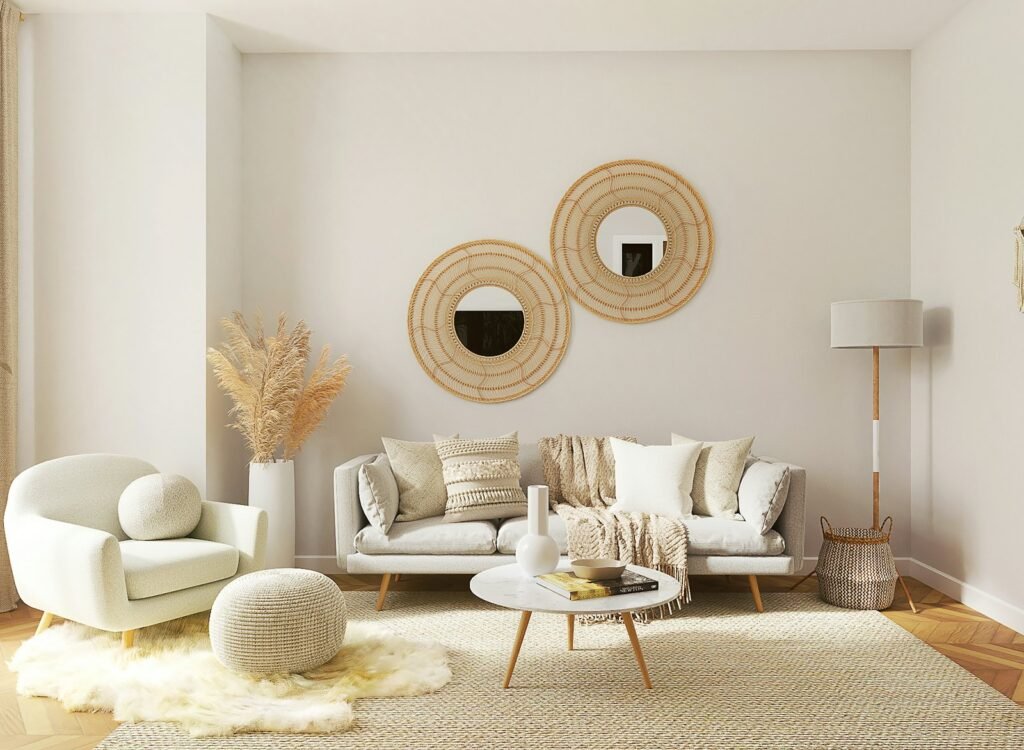
The instinct in a small room is to push everything against the walls to free up the middle. Designers push back on that. Floating the furniture inward, even by a few inches, makes the room read as intentional rather than crammed. Havenly’s stylists note that pulling a sofa 8 to 12 inches forward creates visual depth and lets light move around the piece. The empty strip behind the sofa is not wasted floor. It is the thing that tells the eye the room has room to spare.
The goal is a conversation zone: seats that face each other across a coffee table or ottoman so people can talk without turning their necks. Two loveseats at 60 to 72 inches each, facing across a square coffee table, build a working conversation area in a room as small as 12 by 12 feet. If two sofas will not fit, pair one apartment sofa with two light chairs angled toward it. The chairs should be easy to lift and move, not anchors.
Protect the traffic path. Leave a clear lane of at least 30 to 36 inches for walking through the room, and keep 14 to 18 inches between the sofa edge and the coffee table so knees and shins clear it. When the path and the conversation zone compete, the path wins. A beautiful arrangement you have to sidestep every time gets old fast.
The sofa and seating: get the dimensions right
This is where most small living rooms go wrong. A standard three-seat sofa runs about 84 inches wide and 35 inches deep. Drop that into a tight room and it swallows the floor. The fix is an apartment-size sofa, which keeps three seats but trims the width to roughly 68 to 80 inches and shaves a few inches off the depth. For rooms under 150 square feet, hold the seat depth to 20 to 24 inches so you can sit back without your feet leaving the ground.
A loveseat is the next step down: about 52 to 65 inches wide and roughly 38 inches deep in standard form, with apartment versions trimming the depth toward 30 inches. A loveseat fits where a full sofa overwhelms, and two of them facing each other often beats one oversized sectional. A sectional can work in a small room only if it earns the footprint by replacing every other seat and doubling as a lounge. If it pins you into one corner and blocks a walkway, skip it.
Two more details. Choose a sofa on visible legs. The strip of floor under the frame reads as more space, where a skirted sofa that sits on the rug looks like a solid block. And keep the arms slim. Rolled or bulky arms can add a foot of width that does nothing but take up room.
| Seating type | Width | Depth | Best for |
|---|---|---|---|
| Loveseat (apartment) | 52 to 65 in | 30 to 38 in | Rooms under 130 sq ft, or paired across a coffee table |
| Apartment 3-seat sofa | 68 to 80 in | 32 to 36 in | The everyday choice for 130 to 200 sq ft rooms |
| Standard sofa | 78 to 90 in | 36 to 40 in | Only in rooms wider than 14 ft with clear walls |
| Small sectional | 80 to 95 in (L) | up to 60 in (chaise) | Open-plan corners where it replaces all other seating |
Rugs and scale: the mistake that shrinks the room
The most common small-room error is a rug that is too small. A 4-by-6 or 5-by-7 stranded under the coffee table, with the furniture floating around it on bare floor, chops the room into a small island surrounded by emptiness. The rug should anchor the whole seating group, not just the coffee table.
The working rule: get a rug large enough that at least the front legs of the sofa and the main chairs rest on it. That ties the group together visually. In a tight room you do not need all four legs on the rug; front legs are an accepted designer move that defines the zone without an oversized purchase. Let the rug run at least 6 inches past each end of the sofa, 12 inches if you can. In a 10-by-12 room a 6-by-9 usually lands right; bigger rooms move up to 8-by-10. Keep the rug about 18 inches off the walls in a small room so a margin of floor still shows around the edges.
Storage and verticality
Floor space is the scarce resource, so move storage up the wall. Wall-mounted consoles and floating shelves keep the floor visible underneath, which is the same trick as the legs on the sofa. The eye reads visible floor as a bigger room. Tall, narrow shelving that climbs toward the ceiling draws the gaze up and makes the walls feel higher than they are.
Lean on furniture that does two jobs. A storage ottoman is seating, a footrest, a coffee table with a tray on top, and a place to hide blankets, all in one footprint. Nesting tables pull apart when guests arrive and tuck back to a single footprint the rest of the time. A sofa with a hidden pull-out bed turns the living room into a guest room without a second piece of furniture. For a full breakdown by piece, see the best furniture for small apartments.
Lighting and mirrors to open the room
One ceiling fixture flattens a room. Layer the light instead: an overhead source, a floor lamp in a corner, and a table lamp on a console. Wall-mounted sconces add light at eye level and save the floor and surface space a lamp would cost. The layers give you pools of light at different heights, which makes the room feel deeper after dark.
Mirrors are the cheapest way to add apparent square footage. Hang one large mirror opposite a window so it catches the daylight and throws it back across the room, which brightens the whole space and reads as a second window. A tall vertical mirror adds height; a wide one adds width, so pick the one that fixes your room’s weak axis. Homes and Gardens advises a narrow, simple frame, since an ornate frame fights the room and undoes the effect. Hang it at eye level or a touch higher to pull the gaze up.
What to skip
- The wall-hug reflex. Pushing every piece flat against the walls makes a small room look smaller, not bigger.
- A deep standard sofa. Anything past 36 inches of depth steals floor you cannot spare.
- A tiny floating rug. If only the coffee table sits on it, size up or change the layout.
- Bulky closed storage across the floor. Go up the wall and keep the floor in view.
- A single overhead light. One source flattens the room; layers give it depth.
- An ornate, heavy mirror frame. It overpowers a small wall and cancels the space-opening trick.
For more on furnishing tight New York floor plans, browse our City Living coverage, and if you are shopping the showrooms, here is where to buy furniture in NYC.
Frequently asked questions
What size sofa fits a small living room?
An apartment-size three-seat sofa, roughly 68 to 80 inches wide with 32 to 36 inches of depth, fits most rooms between 130 and 200 square feet. Under 130 square feet, drop to a loveseat around 52 to 65 inches wide. In rooms under 150 square feet, keep the seat depth to 20 to 24 inches so the proportions stay right.
What size rug should I use in a small living room?
Pick a rug big enough to hold at least the front legs of the sofa and the main chairs. In a 10-by-12 room that is usually a 6-by-9. Let the rug run 6 to 12 inches past each end of the sofa and keep it about 18 inches off the walls so a border of floor still shows.
Should furniture be against the wall in a small room?
Not flat against it. Pulling the sofa 8 to 12 inches off the wall creates a sense of depth and lets light pass behind it. Float the seats around a coffee table to build a conversation zone, while keeping a clear 30-inch walking path through the room.
Sources
- Havenly, Living Room Furniture Layout: Floating Furniture Design Tips
- Homes and Gardens, How designers use mirrors to make a room look bigger
- Bassett Furniture, Apartment Size Sofas and Loveseat Dimensions
- Rugs Direct, What Size Rug for a Living Room
- Stamps Home Furniture, Shallow Depth Sofas for Small Spaces
- Living Spaces, Multifunctional Furniture for Small Spaces